Introduction
Artificial intelligence has rapidly evolved from simple rule-based chatbots to sophisticated systems that can reason, use tools, make decisions, and complete tasks with limited human intervention. As a result, two terms are increasingly common in business and technology discussions: AI chatbots and AI agents.
Although the two technologies can appear similar because both may communicate with users through natural language, they are fundamentally different in their capabilities and purpose.
An AI chatbot primarily responds to users, while an AI agent can work toward a goal and take actions. However, the distinction is not always absolute: an AI chatbot can include agentic capabilities, and an AI agent can use a conversational interface.
This article explains the difference between AI agents and AI chatbots, how they work, their advantages, applications, limitations, and how businesses can decide which technology to use.
What Is an AI Chatbot?
An AI chatbot is a software application designed to interact with people through natural-language conversation. It can understand questions or instructions and generate appropriate responses.
Traditional chatbots often relied on predefined rules, decision trees, or scripted responses. Modern AI chatbots increasingly use natural language processing (NLP), machine learning, and large language models (LLMs) to understand context and generate more flexible responses.
For example, a customer visiting an e-commerce website might ask:
"What is the return policy for this product?"
A chatbot can understand the question and provide the relevant information.
Similarly, a banking chatbot might answer questions about account services, while an educational chatbot could explain a concept to a student.
The primary function of a chatbot is therefore conversation and information assistance.
Key characteristics of AI chatbots
Conversational interaction
Question-and-answer capability
Natural-language understanding
Text or voice-based communication
Customer-service automation
Information retrieval
Limited or controlled task execution
Usually reactive to user requests
Modern chatbots can be considerably more sophisticated than traditional scripted systems. Therefore, it is inaccurate to assume that every chatbot is simply a rule-based program.
What Is an AI Agent?
An AI agent is an AI system designed to pursue a goal by planning, reasoning, using available tools, and taking actions with a degree of autonomy.
IBM describes AI agents as systems that can autonomously perform tasks by designing workflows and using available tools. They can make decisions, interact with external systems, and perform actions beyond simply generating a conversational response.
For example, suppose a manager tells an AI system:
"Analyze last month's sales performance, identify the three weakest products, investigate possible reasons, and prepare a report."
A basic chatbot might explain how to perform this analysis.
An AI agent could potentially:
Access the sales database.
Retrieve the relevant data.
Analyze sales performance.
Identify weak-performing products.
Search relevant business information.
Develop possible explanations.
Generate a report.
Send or save the report using an authorized business application.
The important difference is that the agent is not merely producing an answer. It is working through a sequence of actions to accomplish a specified objective.
AI Chatbot vs AI Agent: The Core Difference
The simplest way to understand the distinction is:
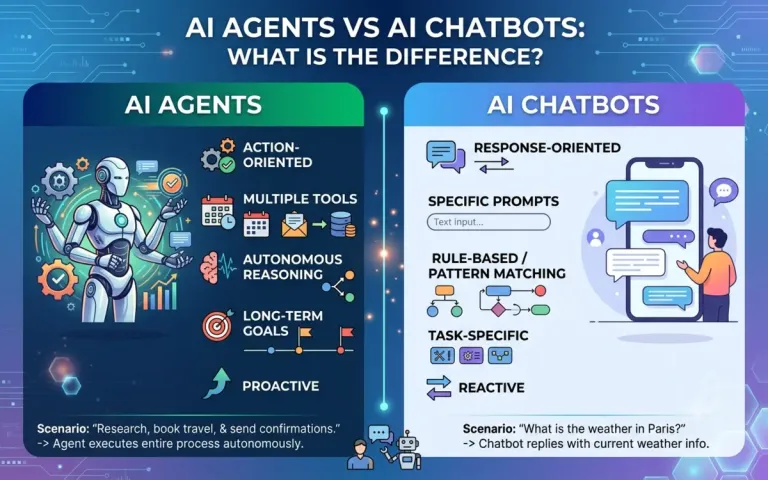
AI chatbot = primarily conversation and response.
AI agent = goal-oriented reasoning and action.
A chatbot generally waits for a user request and responds to it. An agent can break a larger objective into smaller tasks, select appropriate tools, execute actions, evaluate results, and continue until the goal is achieved or human intervention is required.
IBM notes that agentic systems can use tools such as APIs, databases, and web resources to obtain information and complete complex tasks.
AI Agents vs AI Chatbots: Comparison Table
| Feature | AI Chatbot | AI Agent |
|---|---|---|
| Primary purpose | Conversation and assistance | Goal achievement and task execution |
| Interaction | Usually reactive | Can be proactive or reactive |
| Autonomy | Low to moderate | Moderate to high |
| Planning | Usually limited | Can plan multi-step tasks |
| Tool usage | May have limited integrations | Often designed to use multiple tools |
| Decision-making | Generally limited | Can make decisions within defined boundaries |
| Memory | May have conversational memory | Can maintain task/context memory |
| Task complexity | Simple to moderately complex | Moderate to highly complex |
| External systems | Limited or controlled access | Can interact with APIs, databases and applications |
| Multi-step execution | Usually limited | Core capability |
| Human involvement | Often required for complex tasks | Can reduce human involvement, but oversight remains important |
| Typical output | Answer or recommendation | Answer, decision, or completed action |
How AI Chatbots Work
A simplified chatbot workflow looks like this:
User asks a question → AI interprets the request → AI generates/retrieves an answer → User receives the response
For example:
Customer: "What are your business hours?"
Chatbot: "We are open from 9:00 AM to 6:00 PM, Monday to Saturday."
The chatbot has completed its role by providing the requested information.
Modern LLM-powered chatbots can handle much richer conversations. They can summarize documents, generate content, explain concepts, analyze information, and maintain conversational context.
However, their ability to independently complete real-world tasks depends on the tools and agentic capabilities integrated into the system.
How AI Agents Work
AI agents typically involve several interconnected components.
1. Goal
The agent first receives a goal or objective.
For example:
"Find potential customers for our new software product."
2. Planning
The system determines what steps may be required to achieve the objective.
It might decide to:
identify the target market,
search for relevant companies,
collect company information,
evaluate potential customers,
organize the results.
3. Reasoning
The agent evaluates information and determines what should happen next.
4. Tool Use
The agent can potentially use authorized tools such as:
APIs
databases
web search
spreadsheets
CRM systems
email systems
business applications
software tools
5. Action
The agent performs the required operations.
6. Evaluation
The system can examine the results and determine whether additional steps are necessary.
7. Completion
The agent stops when the objective has been achieved, when a predefined condition is reached, or when human approval is required.
This makes the workflow more like:
Goal → Plan → Gather information → Reason → Act → Evaluate → Repeat → Complete
IBM describes this type of agentic operation as autonomous task execution involving planning, tool use, reasoning, and interaction with external environments.
A Simple Example: Customer Service
Consider an online retailer.
Traditional chatbot
A customer asks:
"Where is my order?"
The chatbot retrieves the order status and responds:
"Your order was shipped yesterday and is expected to arrive tomorrow."
This is useful, but the chatbot mainly provides information.
AI agent
Now imagine a customer says:
"My order is late. Please check what happened and resolve the issue."
An AI agent could potentially:
Retrieve the customer's order.
Check shipping information.
Identify the delivery problem.
Check the company's replacement or refund policy.
Determine an appropriate resolution.
Request approval if necessary.
Create a support case.
Initiate an authorized refund or replacement.
Notify the customer.
The agent has moved from answering a question to executing a workflow.
Another Example: Marketing
The difference becomes particularly clear in digital marketing.
AI chatbot
A marketing professional might ask:
"Give me five ideas for a social media campaign."
The chatbot generates five campaign ideas.
AI agent
A marketing agent could receive:
"Create and execute a campaign for our new product."
Depending on its permissions and integrations, the agent could:
analyze previous campaign performance,
identify target customer segments,
research competitors,
develop campaign ideas,
create content,
prepare advertisements,
organize campaign assets,
schedule approved posts,
monitor performance,
analyze engagement,
recommend adjustments.
The human may still need to approve important decisions, budgets, advertisements, or external communications.
Major Differences Between AI Agents and AI Chatbots
1. Conversation vs Action
The fundamental distinction is between communication and execution.
Chatbots are primarily designed to communicate with users.
AI agents are designed to accomplish objectives through actions.
A chatbot might tell you:
"You can create a sales report using your CRM data."
An agent may actually retrieve the data and create the report if it has the necessary permissions and tools.
2. Reactive vs Goal-Oriented
Traditional chatbots are generally reactive.
They wait for an instruction and respond.
Agents are more goal-oriented. A user can provide an objective, and the agent can determine the sequence of actions needed to accomplish it.
This does not mean agents operate without constraints. Their behavior still depends on their system design, available tools, permissions, policies, and human-defined objectives.
3. Single-Step vs Multi-Step Tasks
Chatbots are particularly effective for individual questions and straightforward interactions.
AI agents are designed for workflows involving multiple steps.
For example:
Chatbot:
"What is the average sales growth rate?"
Agent:
"Calculate the average sales growth rate, compare it with last year's performance, identify the major causes of changes, and prepare an executive summary."
The second task requires multiple operations and potentially multiple sources of information.
4. Limited Tools vs Tool Integration
A chatbot may simply generate an answer from its model or retrieve information from a connected knowledge base.
An AI agent can be designed to select and use external tools.
For example:
User → Agent → CRM → Database → Analytics Tool → Email System → User
Tool use is one of the important characteristics separating agentic systems from simple non-agentic chatbots.
5. Limited Context vs Persistent Context
Many basic chatbots have limited conversational context.
More advanced systems can remember previous interactions, but memory is not automatically equivalent to agency.
An agent may combine memory with planning and tool use to maintain continuity across a longer task.
For example:
"Last week you asked me to monitor our competitors. Check the latest developments and update the report."
An appropriately designed agent can use stored context and connected information sources to continue the workflow.
Are All AI Chatbots Simple?
No.
This is an important distinction.
The terms chatbot and AI agent describe different aspects of an AI system.
A chatbot describes primarily a conversational interface or application.
An agent describes a system's ability to pursue goals and take actions.
Therefore, a system can be both:
AI chatbot + AI agent
For example, a conversational interface can allow a user to communicate with an agent.
IBM explicitly distinguishes chatbot as a modality from agency as a technological framework.
This means the relationship can be represented as:
Chatbot = How the user communicates with the system
Agent = How the system reasons and acts
This is why the statement "all chatbots are basic and all agents are advanced" is too simplistic.
AI Agents and Generative AI
AI agents are closely connected to generative AI.
Generative AI can create:
text,
images,
code,
summaries,
reports,
recommendations,
other forms of content.
An AI agent can use generative AI as its reasoning and language component while adding:
tools,
memory,
planning,
workflows,
external data,
decision-making,
action capabilities.
IBM describes agentic AI as building on generative AI and using LLMs to operate toward specific goals in dynamic environments.
Therefore:
Generative AI creates content.
AI agents use AI capabilities to pursue goals and perform tasks.
The two concepts overlap, but they are not identical.
Business Applications of AI Chatbots
AI chatbots are particularly useful in situations involving frequent communication and information requests.
Customer service
Chatbots can answer:
product questions,
delivery questions,
return-policy questions,
account-related questions,
frequently asked questions.
Sales
They can:
answer product questions,
qualify leads,
provide product information,
guide customers through purchasing decisions.
Education
Educational chatbots can:
explain concepts,
answer student questions,
provide practice questions,
assist with learning.
Human resources
HR chatbots can answer questions regarding:
company policies,
leave procedures,
benefits,
employee documentation.
Website assistance
Website chatbots can help visitors navigate content and locate information.
Business Applications of AI Agents
AI agents are especially valuable where organizations need automation across multiple systems.
Marketing
Agents can potentially:
analyze campaign data,
research competitors,
generate marketing materials,
monitor campaigns,
prepare reports.
Sales
Sales agents can:
research prospects,
update CRM records,
prioritize leads,
prepare personalized communication,
schedule follow-ups.
Customer service
Agents can:
investigate customer problems,
retrieve account information,
create tickets,
coordinate multiple systems,
recommend resolutions.
Finance
Agents can assist with:
financial analysis,
invoice processing,
reporting,
anomaly identification,
reconciliation workflows.
Human resources
Agents can assist with:
candidate screening,
interview scheduling,
employee queries,
onboarding workflows,
document processing.
IT operations
Agents can potentially:
monitor systems,
investigate incidents,
analyze logs,
create tickets,
execute approved remediation procedures.
AI agents are increasingly being explored across software development, IT automation, customer support, finance, HR, and other enterprise functions.
Advantages of AI Chatbots
AI chatbots offer several important benefits.
1. 24/7 availability
A chatbot can respond to customers at any time.
2. Faster responses
Customers do not always need to wait for a human representative.
3. Cost reduction
Automating repetitive inquiries can reduce the workload on customer-service teams.
4. Scalability
One chatbot can potentially handle many conversations simultaneously.
5. Consistency
For standardized questions, chatbots can provide consistent answers.
6. Easy access to information
Users can obtain information through natural-language interaction.
Advantages of AI Agents
AI agents offer broader capabilities.
1. Automation of complex workflows
Agents can coordinate multiple steps rather than simply answering individual questions.
2. Productivity improvement
Employees can delegate repetitive and multi-step tasks.
3. Tool integration
Agents can interact with enterprise systems and external tools where authorized.
4. Personalization
Agents can use relevant context and information to adapt their actions.
5. Continuous task execution
Some agents can work through longer processes instead of stopping after producing a single response.
6. Decision support
Agents can analyze information and recommend or execute actions within defined boundaries.
Microsoft similarly describes agents as systems that can automate tasks, connect to organizational knowledge, and execute business processes.
Limitations of AI Chatbots
Despite their usefulness, chatbots have limitations.
Limited task execution
A chatbot may be unable to perform actions outside its available integrations.
Context limitations
Some systems struggle with long or complex conversations.
Incorrect information
Generative AI chatbots can sometimes produce inaccurate or misleading information.
Dependence on human input
Complex tasks may require the user to provide instructions at each stage.
Integration limitations
A chatbot without access to business systems cannot independently perform many real-world tasks.
Limitations and Risks of AI Agents
The increased autonomy of AI agents also introduces greater risks.
1. Incorrect decisions
An agent can make an incorrect decision and potentially act on it.
2. Excessive autonomy
Giving an AI system excessive permissions can create operational and security risks.
3. Data privacy
Agents may access sensitive business information if appropriate controls are not implemented.
4. Security risks
Agents connected to external systems can potentially create larger consequences if compromised or misconfigured.
5. Cost
Complex agents may require more computing resources, API calls, and infrastructure than simple chatbots.
6. Lack of transparency
It can sometimes be difficult to understand why an autonomous system selected a particular action.
7. Cascading errors
In multi-agent or multi-step systems, an error in one stage can affect subsequent stages.
IBM highlights the need for clear goals, safeguards, feedback loops, and appropriate controls because autonomous systems can produce unintended behavior.
Human Oversight Remains Important
The rise of AI agents does not mean businesses should completely remove humans from important processes.
For high-impact activities, organizations should consider:
human approval,
access controls,
audit logs,
monitoring,
data protection,
predefined boundaries,
escalation procedures,
testing,
accountability.
Microsoft emphasizes that delegating work to AI does not transfer accountability; people remain responsible for reviewing and approving how automated work is used.
A useful principle is:
Automate execution, but retain appropriate human accountability.
When Should a Business Use an AI Chatbot?
An AI chatbot may be the better option when the business primarily needs:
customer FAQs,
website assistance,
basic product information,
simple lead qualification,
employee information support,
conversational assistance,
basic troubleshooting.
For example, a small business website receiving hundreds of repetitive questions may not need a sophisticated autonomous agent.
A well-designed chatbot may provide an affordable and effective solution.
When Should a Business Use an AI Agent?
An AI agent becomes more attractive when the business needs:
multi-step task automation,
integration with several applications,
continuous workflows,
complex research,
data analysis,
decision support,
automated business processes,
personalized actions,
workflow orchestration.
Microsoft's current guidance similarly distinguishes agents from ordinary assistance when autonomous tool use and multi-step work are required.
AI Chatbots and AI Agents Can Work Together
Businesses do not necessarily need to choose one technology over the other.
A chatbot can serve as the front-end conversational interface, while AI agents operate behind the scenes.
For example:
Customer → Chatbot → AI Agent → CRM → Order System → Payment System → Customer
The customer simply communicates through the chatbot.
Behind the interface, an agent may coordinate multiple systems to complete the request.
This architecture can provide the convenience of conversational AI while enabling sophisticated automation.
Microsoft describes a similar model in which Copilot can act as an interface through which users interact with specialized agents.
The Future of AI Agents and Chatbots
The distinction between chatbots and agents will likely become less obvious as conversational AI becomes more capable.
Future AI systems are increasingly likely to combine:
natural-language conversation,
long-term context,
reasoning,
planning,
memory,
tool use,
automation,
multimodal interaction,
specialized agents,
human oversight.
Instead of simply asking an AI:
"What should I do?"
users may increasingly be able to say:
"Here is my objective. Analyze the situation, develop a plan, and complete the tasks that you are authorized to perform."
This represents a shift from AI as an information assistant toward AI as a digital work partner.
However, greater autonomy also increases the importance of governance, security, monitoring, and human oversight.
AI Agents vs AI Chatbots: A Simple Way to Remember
You can remember the distinction using three words:
Chatbot → Talk
It primarily communicates with the user.
Generative AI → Create
It generates content, ideas, analysis, code, or other outputs.
AI Agent → Act
It can pursue a goal by planning, using tools, and executing tasks.
In simplified form:
Chatbot = Conversation
Generative AI = Creation
AI Agent = Goal + Reasoning + Action
These categories can overlap, but the distinction is useful for understanding how AI systems are evolving.
Conclusion
AI chatbots and AI agents are both important technologies in the development of artificial intelligence, but they serve different purposes.
AI chatbots primarily focus on conversation, information delivery, and user assistance. AI agents go further by pursuing goals, planning multi-step workflows, using tools, and taking actions within defined boundaries.
The difference is therefore not simply about how intelligent the system appears. It is about what the system is capable of doing.
A chatbot might tell a customer how to request a refund. An AI agent may be capable of checking the order, determining eligibility, initiating the appropriate workflow, and updating the customer—provided it has the necessary tools and authorization.
For businesses, the choice should depend on the problem being solved. Simple information and communication requirements may be handled effectively by chatbots. Complex, repetitive, multi-step workflows may benefit from agentic AI.
The most effective future systems may combine both: a conversational interface for humans and intelligent agents working behind the scenes to execute authorized tasks.
As AI continues to move from generating answers toward performing actions, understanding the difference between chatbots and AI agents will become increasingly important for managers, marketers, technology professionals, and business leaders.
Related articles
AI and Cybersecurity: How Artificial Intelligence Is Changing Digital Security
AI Hallucinations: Why AI Can Generate Incorrect Information and How to Verify It
AI in Business: Applications Across Modern Organizations
AI and Employment: How Artificial Intelligence Is Changing Jobs and Skills
Artificial Intelligence and Personal Data Privacy: Risks, Challenges, and Best Practices
Generative AI vs Traditional AI: Understanding the Key Differences
Frequently Asked Questions (FAQs)
1. What is the main difference between an AI chatbot and an AI agent?
An AI chatbot primarily communicates with users and provides responses, whereas an AI agent is designed to pursue goals by planning, using tools, making decisions, and executing tasks.
2. Is ChatGPT a chatbot or an AI agent?
The answer depends on the capabilities and configuration being discussed. A conversational AI system can function as a chatbot, while agentic capabilities can enable it to use tools and perform multi-step tasks. Therefore, "chatbot" and "agent" should not always be treated as mutually exclusive categories.
3. Are AI agents better than chatbots?
Not necessarily. They solve different problems. A chatbot may be more appropriate for FAQs and customer communication, while an AI agent may be more appropriate for complex workflows and task automation.
4. Can an AI chatbot become an AI agent?
Yes. A conversational system can be extended with capabilities such as tools, memory, planning, APIs, and task execution, allowing it to behave as an agentic system.
5. Are AI agents fully autonomous?
No. The degree of autonomy varies. AI agents operate within goals, permissions, tools, policies, and technical constraints defined by their developers and organizations. Human oversight may still be necessary, particularly for high-impact decisions.
6. What is agentic AI?
Agentic AI refers to AI systems capable of pursuing goals with a degree of autonomy. Such systems can use reasoning, planning, tools, memory, and external systems to accomplish tasks.
7. Why are AI agents important for businesses?
AI agents can automate complex, multi-step workflows and interact with business systems, potentially improving productivity and reducing repetitive work. Their value is greatest when the workflow is suitable for automation and appropriate safeguards are in place.