Introduction
Artificial Intelligence is no longer limited to research laboratories or highly specialized technology companies. It is becoming part of everyday work across industries.
Businesses are using AI to analyze information, automate repetitive activities, assist customers, generate content, support decision-making, write software, detect patterns, and improve operational efficiency.
This development has created both opportunities and concerns for workers.
One of the most common questions is:
Will Artificial Intelligence replace human workers?
The answer is more complicated than simply saying yes or no.
AI can automate some tasks that people currently perform, but it can also assist employees, create new responsibilities, transform existing occupations, and increase demand for new skills. The International Labour Organization has emphasized that the impact of Generative AI is likely to involve significant transformation of many jobs rather than the complete disappearance of most occupations.
Therefore, the more useful question is not simply whether AI will replace jobs.
A better question is:
How will AI change the tasks people perform, the skills employers require, and the way organizations structure work?
How AI Is Changing the Workplace
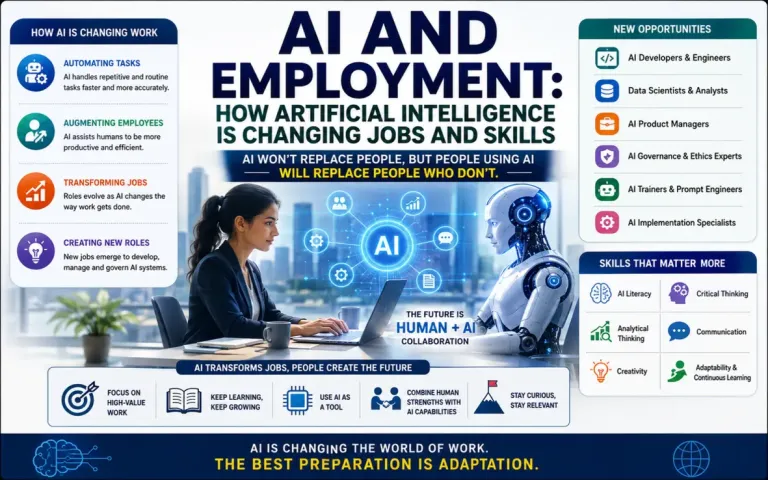
AI can affect employment in several different ways.
1. Automating tasks
AI can perform certain repetitive or predictable tasks with limited human intervention.
2. Augmenting employees
AI can help workers perform their existing jobs more efficiently.
3. Transforming occupations
The responsibilities associated with an existing job may change as AI takes over some activities.
4. Creating new roles
The adoption of AI creates demand for people who can develop, implement, manage, evaluate, and govern AI systems.
These four effects can happen simultaneously.
For example, an organization may introduce an AI customer-service system that handles simple queries while human employees focus on complex customer problems.
The technology therefore does not necessarily eliminate the entire occupation. Instead, the composition of the job changes.
AI Often Automates Tasks Rather Than Entire Jobs
One of the most important concepts for understanding AI and employment is the difference between a job and a task.
A job usually consists of many different activities.
For example, a marketing executive might:
Research customers
Analyze market information
Prepare reports
Write content
Communicate with clients
Develop campaigns
Present recommendations
Coordinate with other departments
AI may be capable of assisting with several of these tasks.
However, that does not necessarily mean the entire marketing role can be automated.
The same principle applies to teachers, accountants, managers, designers, developers, researchers, and many other professionals.
The effect of AI therefore needs to be considered at the task level, rather than assuming that every occupation will either disappear or remain unchanged.
Which Jobs Are More Exposed to AI?
Jobs involving large amounts of digital information and repetitive cognitive activities may be particularly exposed to AI-driven transformation.
Examples can include certain activities involving:
Data processing
Document preparation
Basic content generation
Routine customer communication
Administrative work
Information classification
Standardized reporting
Basic coding assistance
However, exposure does not automatically mean job elimination.
The International Labour Organization's research indicates that clerical occupations have among the highest exposure to Generative AI, while many other occupations are more likely to experience transformation rather than full automation.
This distinction is extremely important.
Exposure ≠ replacement.
A task being technically automatable does not necessarily mean that an organization will automate it.
Jobs That May Be More Resistant to Complete Automation
Some work depends heavily on capabilities that are difficult to reproduce through automation alone.
These may include:
Complex interpersonal communication
Leadership
Negotiation
Empathy
Physical work in unpredictable environments
Relationship management
Ethical judgment
Strategic decision-making
Creative direction
Context-dependent problem solving
For example, a manager may use AI to analyze business information, but managing people still involves communication, motivation, conflict resolution, judgment, and relationship building.
Similarly, a teacher can use AI to create learning materials, but teaching also involves understanding students, adapting explanations, encouraging participation, and responding to individual needs.
This does not mean these occupations are immune to AI.
Instead, AI may change how these professionals perform their work.
AI Can Increase Employee Productivity
One of the strongest arguments for workplace AI is its ability to assist employees.
Consider a software developer.
AI may help the developer:
Generate code suggestions
Explain unfamiliar code
Identify potential errors
Create documentation
Generate test cases
The developer still needs to understand the problem, evaluate the generated code, test it, and make the final decisions.
Similarly, a researcher may use AI to organize information, while a marketing professional may use AI to generate initial content ideas.
In these situations, AI acts as an assistant rather than a complete replacement.
The productivity impact can be significant when AI is used appropriately and combined with human expertise.
AI Is Changing the Nature of Jobs
AI adoption can change not only the number of tasks employees perform but also which tasks become more important.
Suppose an employee previously spent 60% of their working time preparing routine reports.
If AI reduces this to 20%, the remaining time could potentially be redirected toward:
Analysis
Strategy
Communication
Problem-solving
Client relationships
Innovation
The employee's job has therefore changed.
This is one reason why discussions about AI and employment should focus on job transformation, not only job elimination.
New Jobs Created by Artificial Intelligence
Technological change can eliminate certain activities while creating demand for new types of work.
AI is already creating or expanding roles related to:
AI development
Machine learning
Data science
AI product management
AI governance
AI risk management
AI security
Data engineering
AI implementation
AI training and evaluation
Some emerging roles may not exist in exactly the same form in the future.
Organizations also need professionals who understand both AI and a particular business domain.
For example:
AI + Marketing
AI + Finance
AI + Human Resources
AI + Healthcare
AI + Education
This combination of technological knowledge and domain expertise can become increasingly valuable.
The Growing Importance of AI Literacy
Not every professional needs to become an AI engineer.
However, many professionals will benefit from understanding how AI systems work and how to use them responsibly.
This is often described as AI literacy.
AI literacy can include understanding:
What AI can and cannot do
How AI generates outputs
How to write effective instructions
How to evaluate AI-generated information
How to protect confidential information
How to recognize AI-related risks
When human judgment is necessary
AI literacy can therefore become a basic workplace capability in much the same way that digital literacy became important during earlier technological transformations.
Skills That Will Become More Important
The increasing use of AI does not mean that technical skills are the only skills that matter.
In fact, AI may increase the value of a combination of technical, analytical, and human skills.
1. AI and Digital Skills
Professionals can benefit from learning:
AI tools
Data analysis
Automation
Digital platforms
Basic AI concepts
Prompting techniques
AI-assisted workflows
The specific technical requirement will vary by profession.
2. Analytical Thinking
AI can generate information quickly, but humans still need to determine:
Is the information correct?
Is it relevant?
What does it mean?
What decision should be made?
Analytical thinking therefore becomes increasingly important.
3. Critical Thinking
AI-generated content can appear convincing even when it contains errors.
Workers need to evaluate outputs rather than automatically accepting them.
This makes critical thinking particularly important in AI-assisted workplaces.
4. Communication Skills
AI can generate text, but effective communication involves understanding people, situations, expectations, and organizational context.
Professionals who can communicate clearly with colleagues, customers, managers, and stakeholders will continue to have an important role.
5. Creativity
AI can generate many possible ideas, but humans still need to determine:
Which idea is valuable?
Which idea fits the audience?
What problem should be solved?
How should the idea be implemented?
Creative thinking can therefore complement AI rather than simply compete with it.
6. Adaptability and Continuous Learning
Technology changes quickly.
A skill that is valuable today may become less valuable tomorrow.
Professionals therefore need the ability to continuously learn and adapt.
The World Economic Forum's Future of Jobs Report 2025 identifies technological change, including AI and information-processing technologies, as a major force reshaping jobs and skills, while emphasizing the growing importance of both technological and human capabilities.
The Rise of Human-AI Collaboration
The future workplace is unlikely to consist simply of:
Humans vs AI
A more realistic model is:
Humans + AI
In this model:
AI can provide:
Speed
Pattern recognition
Data processing
Automation
Content generation
Information assistance
Humans can provide:
Judgment
Context
Accountability
Empathy
Leadership
Creativity
Ethical reasoning
The combination can potentially produce better outcomes than either working independently.
AI and the Changing Role of Managers
Managers will also need to adapt.
Previously, managers primarily focused on managing people, processes, budgets, and performance.
In an AI-enabled workplace, managers may additionally need to understand:
Where AI can add value
Which tasks should remain human-led
How AI affects employee responsibilities
How AI outputs should be evaluated
How employee data should be protected
How AI risks should be managed
This means management itself may become more technology-oriented.
However, the human side of management remains important.
AI can provide analysis, but managers still need to make decisions, communicate those decisions, manage teams, and accept responsibility for outcomes.
AI and Employment: The Risk of Job Displacement
Despite the potential benefits, concerns about job displacement are legitimate.
If AI can perform a particular task faster and more cheaply, organizations may have an incentive to reduce the amount of human labor required for that task.
This can create difficulties for workers whose existing skills are closely associated with highly automatable activities.
Potential consequences include:
Job losses in some occupations
Reduced demand for certain skills
Wage pressure in some roles
Increased competition
Greater inequality between workers with different levels of AI exposure
The effects are unlikely to be evenly distributed across industries, occupations, countries, or demographic groups.
The ILO's research similarly emphasizes that the impact of Generative AI will differ significantly across occupations and that job transformation is an important part of the overall picture.
Why AI Does Not Automatically Mean Mass Unemployment
It is tempting to assume:
More AI → Fewer workers → Mass unemployment
But the relationship is not that simple.
When technology increases productivity, organizations may also:
Expand production
Introduce new products
Reduce costs
Enter new markets
Create new services
Increase demand for complementary skills
Historically, technological change has often involved both displacement and creation of work.
AI may follow a similar pattern, although its scale and speed create new challenges.
The key question is therefore not whether technology changes employment.
It is:
How quickly can workers, organizations, and education systems adapt to that change?
How Professionals Can Prepare for an AI-Driven Workplace
Professionals do not necessarily need to predict exactly which jobs AI will eliminate.
A more practical approach is to identify how AI can change the tasks within their own profession.
Step 1: Understand AI
Learn the fundamentals of:
AI
Machine learning
Generative AI
LLMs
AI tools
AI limitations
Step 2: Identify AI-Related Changes in Your Profession
Ask:
Which tasks in my current job can AI assist with?
Then ask:
Which tasks require human judgment and expertise?
This helps identify where adaptation is needed.
Step 3: Learn Relevant AI Tools
Do not attempt to learn every AI application.
Instead, identify the tools relevant to your profession.
For example:
Marketing professional → AI content, analytics and research tools
Developer → AI coding assistants
Teacher → AI-assisted educational tools
Researcher → AI research and analysis tools
Business manager → AI analytics and decision-support tools
The Importance of Combining AI Skills With Domain Expertise
One of the strongest career strategies may be to combine AI knowledge with existing professional expertise.
For example:
Marketing + AI
can be more valuable than simply knowing how to use an AI chatbot.
Similarly:
Finance + AI
HR + AI
Education + AI
Web Development + AI
can create specialized capabilities.
The future may therefore reward professionals who can answer:
How can AI solve problems in my field?
rather than simply:
How do I use an AI tool?
How Businesses Can Prepare Their Employees
Organizations also have a responsibility to help employees adapt.
Instead of treating AI purely as a cost-reduction technology, businesses can invest in:
AI training
Digital skills
Reskilling
Upskilling
Human-AI collaboration
Responsible AI practices
Internal mobility
This can help employees transition toward tasks where human expertise remains valuable.
A successful AI strategy should therefore consider both technology adoption and workforce development.
AI, Education, and the Future Workforce
Education systems will also need to respond.
Traditional education often emphasizes acquiring knowledge and completing predefined tasks.
But if AI can provide instant access to information and generate routine outputs, education may need to place greater emphasis on:
Critical thinking
Problem-solving
Creativity
Communication
Collaboration
Digital literacy
AI literacy
Ethical reasoning
Students will increasingly need to understand not only how to use AI, but also when not to use it and how to evaluate its output.
This is particularly important because future professionals are likely to enter workplaces where AI is already embedded in many processes.
The Future of Employment in the Age of AI
The future of employment will probably not be defined by a simple choice between humans and machines.
Instead, workplaces are likely to develop new combinations of:
Human expertise + AI systems + Data + Automation
Some jobs will decline.
Some will change significantly.
Some new jobs will emerge.
And many existing jobs will increasingly involve collaboration with AI.
The most adaptable professionals may not necessarily be those who know the most about AI technology itself.
They may be those who understand:
What AI can do
What AI cannot reliably do
How AI can be applied to their profession
How to evaluate AI outputs
How to combine AI with human judgment
Conclusion
Artificial Intelligence is changing employment by altering the tasks people perform, the skills organizations require, and the way work is organized.
Although some tasks and occupations are vulnerable to automation, AI is also creating opportunities for productivity improvements, new roles, and new forms of human-AI collaboration.
The most important shift may therefore be from thinking about AI replacing people to understanding how AI changes the work people do.
For professionals, the response should not be fear or passive waiting.
It should be continuous learning, AI literacy, domain expertise, critical thinking, and adaptability.
For businesses, successful AI adoption will require more than purchasing AI tools. Organizations will need to redesign workflows, train employees, protect data, manage risks, and determine where human judgment remains essential.
The future of work will ultimately depend not only on how powerful AI becomes, but also on how effectively humans learn to work with it.
Frequently Asked Questions
Will AI replace human jobs?
AI is likely to automate some tasks and transform many occupations, while also creating new roles and opportunities. The impact will vary considerably across occupations and industries.
Which jobs are most affected by AI?
Jobs involving repetitive, predictable, and highly digitized tasks may have greater exposure to AI. However, exposure to AI does not necessarily mean complete job replacement.
What skills are important in the AI era?
AI literacy, digital skills, analytical thinking, critical thinking, creativity, communication, problem-solving, adaptability, and domain expertise are increasingly valuable.
Do I need to learn programming to work with AI?
Not necessarily. The technical skills required depend on the profession. Many professionals can benefit from AI literacy and effective use of AI tools without becoming programmers.
How can employees protect their careers from AI?
Rather than trying to compete directly with AI, professionals should learn how AI affects their field, develop complementary skills, understand relevant AI tools, and strengthen capabilities that require human judgment and expertise.
Will AI create new jobs?
Yes. AI is creating demand for roles related to AI development, data, implementation, governance, security, evaluation, and specialized applications. It can also create new responsibilities within existing professions.
Related Articles
Artificial Intelligence: A Complete Guide to AI, Its Types, Applications, and Impact
How Does Artificial Intelligence Work? A Beginner's Guide
Machine Learning vs Artificial Intelligence: What Is the Difference?
What Is Generative AI? How It Works and Where It Is Used
Generative AI vs Traditional AI: Understanding the Key Differences
Large Language Models (LLMs): What They Are and How They Work
Artificial Intelligence and Personal Data Privacy: Risks, Challenges, and Best Practices
References
International Labour Organization (ILO).
Generative AI and Jobs: A Global Analysis of Potential Effects on Job Quantity and Quality.
ILO
World Economic Forum.
The Future of Jobs Report 2025.
World Economic Forum
National Institute of Standards and Technology (NIST).
Artificial Intelligence Risk Management Framework: Generative Artificial Intelligence Profile.
NIST Publications