Introduction
Human Resource Management (HRM) has traditionally involved activities such as recruitment, employee training, performance management, payroll administration, workforce planning and employee engagement. As organizations become more data-driven and digitally connected, these activities are increasingly being supported by technology.
One of the most significant technological developments affecting HR is Artificial Intelligence (AI).
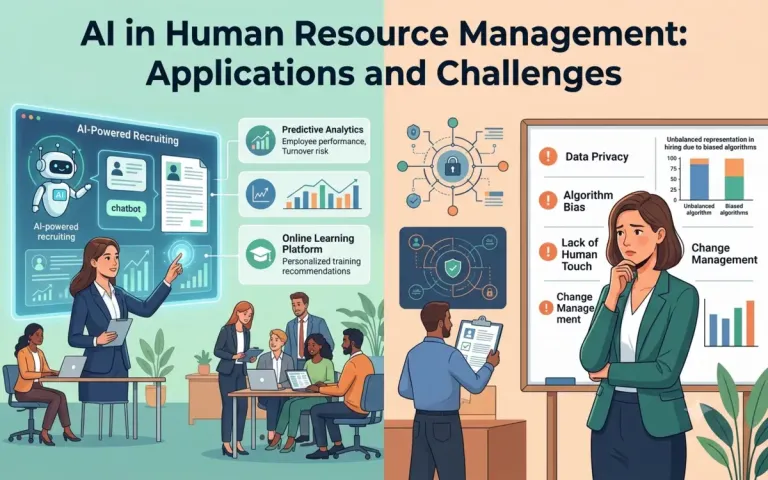
AI is changing HR from a primarily administrative function into a more data-driven and strategically oriented function. Organizations can use AI to screen resumes, identify suitable candidates, answer employee questions, analyze workforce data, personalize training, predict employee turnover and automate routine HR processes.
However, the adoption of AI in HR also creates important challenges. Human resources involves people, personal information, organizational culture and employment decisions. Consequently, issues such as algorithmic bias, privacy, transparency, accountability and human oversight become particularly important.
The real question is therefore not whether AI should be used in HR, but:
How can organizations use AI to improve HR processes while preserving fairness, privacy, transparency and human judgment?
What Is AI in Human Resource Management?
AI in Human Resource Management refers to the application of artificial intelligence technologies to perform, support or improve HR-related activities.
These technologies may include:
Machine learning
Natural language processing (NLP)
Generative AI
Predictive analytics
Computer vision
Conversational AI
AI-powered recommendation systems
Intelligent automation
AI can process large volumes of structured and unstructured information and identify patterns that may be difficult to analyze manually.
For example, an organization receiving thousands of job applications can use AI to organize applications according to predefined job-related criteria. Similarly, an HR department can use conversational AI to answer routine employee questions about leave policies, benefits or company procedures.
Importantly, AI should generally be viewed as a decision-support and process-automation technology, rather than a complete replacement for HR professionals.
Why Is AI Becoming Important in HRM?
The HR function generates a considerable amount of information.
This includes:
Employee profiles
Resumes
Attendance records
Performance information
Training records
Compensation information
Employee feedback
Job descriptions
Recruitment data
Workforce analytics
Traditionally, HR professionals have had to process much of this information manually.
AI can help organizations transform this information into actionable insights.
For example:
HR Data → AI Analysis → Insights → HR Decision → Business Action
This can improve the speed and efficiency of HR processes.
AI also enables HR professionals to spend less time on repetitive administrative activities and more time on activities requiring human judgment, communication and strategic thinking.
Major Applications of AI in Human Resource Management
1. AI-Powered Recruitment
Recruitment is one of the most prominent applications of AI in HR.
Organizations can receive hundreds or thousands of applications for a single position. Reviewing every application manually can be time-consuming.
AI can assist with:
Resume parsing
Candidate matching
Job description analysis
Candidate sourcing
Application categorization
Interview scheduling
Recruitment communication
Candidate recommendations
For example:
Job Description → Applications → AI Screening → Candidate Shortlist → Human Review → Interview
AI can help recruiters focus their attention on candidates who meet relevant job-related requirements.
However, the criteria used by the AI system must be carefully designed because an automated system can reproduce biases contained in historical recruitment data.
2. Resume Screening and Candidate Shortlisting
Recruiters often need to evaluate large numbers of resumes.
AI-based systems can extract information such as:
Education
Skills
Work experience
Certifications
Industry experience
Technical competencies
The system can compare this information with job requirements.
For example, suppose an organization is recruiting a digital marketing manager.
The AI system may identify candidates with experience in:
SEO
Search advertising
Social media marketing
Analytics
Content marketing
Campaign management
The recruiter can then review the AI-generated shortlist.
Important limitation
AI should not automatically determine who is hired.
Candidate selection involves factors that may not be fully represented in a resume, such as communication, leadership, cultural contribution and contextual suitability.
Therefore:
AI Screening + Human Judgment = Better Recruitment Process
3. AI Chatbots for Employee Support
HR departments receive many repetitive questions.
Employees may ask:
How many leaves do I have?
What is the leave policy?
How do I submit an expense claim?
When is salary processed?
What documents are required?
How can I update my personal information?
An AI-powered HR chatbot can provide immediate answers based on authorized organizational information.
A typical workflow could be:
Employee Question → AI Understands Query → Retrieves HR Policy → Generates Response
If the question is complex, the system can transfer the conversation to an HR professional.
This creates a human-AI service model rather than a fully automated HR department.
4. Employee Onboarding
Employee onboarding involves multiple administrative activities.
A traditional onboarding process may require HR employees to manually coordinate:
Welcome communication
Document collection
Policy distribution
Training schedules
IT access
Department introductions
Manager notifications
AI-powered workflow automation can coordinate these activities.
For example:
Employee Selected → HR System Trigger → Welcome Email → Documents → IT Setup → Training Assignment → Manager Notification
AI can also personalize onboarding based on the employee's role and department.
This can reduce administrative workload while providing new employees with a more organized experience.
5. Learning and Development
AI can help organizations move from standardized training toward personalized learning.
Traditional training often provides the same content to employees in similar roles.
AI can analyze:
Employee skills
Job role
Performance information
Learning history
Career objectives
Identified skill gaps
The system can then recommend appropriate learning resources.
For example:
Employee Data → Skill-Gap Analysis → Learning Recommendation → Training → Progress Monitoring
An employee working in marketing might receive recommendations related to:
Digital analytics
SEO
Consumer behavior
Marketing automation
Data visualization
This can make employee development more individualized.
6. Performance Management
AI can support performance management by analyzing relevant workplace information.
Potential applications include:
Performance trend analysis
Goal tracking
Feedback analysis
Productivity insights
Performance dashboards
Identification of skill-development needs
Instead of relying entirely on an annual performance review, organizations can use data to provide more continuous insights.
However, organizations must be careful about what data they use.
A simple productivity metric may not accurately represent an employee's overall contribution.
For example, an employee who handles complex customer problems may complete fewer cases than another employee handling simple requests.
Therefore, AI-generated performance insights should support—not replace—managerial judgment.
7. Employee Engagement Analysis
Employee engagement is another area where AI can assist HR professionals.
AI can analyze employee feedback from authorized sources and identify common themes.
For example, an organization may discover recurring concerns about:
Workload
Management
Compensation
Career development
Workplace communication
Training
Work-life balance
Natural language processing can help classify large volumes of feedback.
The process may look like:
Employee Feedback → NLP Analysis → Sentiment/Theme Identification → HR Dashboard → Management Action
However, employee privacy and consent are critical when analyzing workplace communications.
8. Predictive HR Analytics
One of the more advanced applications of AI is predictive analytics.
Instead of only asking:
"What happened?"
HR can potentially ask:
"What is likely to happen?"
AI can analyze historical workforce data to identify patterns associated with outcomes such as:
Employee turnover
Absenteeism
Recruitment demand
Training requirements
Workforce shortages
For example, a predictive model might identify that certain employees have characteristics historically associated with higher turnover risk.
However, such predictions should not be treated as facts.
A prediction that an employee may leave does not mean that the employee will leave.
HR professionals should investigate the underlying factors and avoid taking adverse action based solely on algorithmic predictions.
9. Workforce Planning
AI can help organizations forecast future workforce requirements.
Suppose a company expects business expansion over the next two years.
HR may need to estimate:
Number of employees required
Skills needed
Recruitment timelines
Training requirements
Departmental workforce distribution
AI can analyze historical workforce patterns, business forecasts and other relevant information to support workforce planning.
This can help HR become more closely connected with organizational strategy.
10. Compensation and Benefits Analysis
AI and analytics can support compensation analysis by helping organizations evaluate:
Salary structures
Compensation trends
Benefits utilization
Workforce costs
Internal pay patterns
AI may identify unusual patterns requiring further investigation.
However, compensation decisions involve legal, ethical and organizational considerations. Automated recommendations therefore require appropriate human oversight.
11. HR Document Automation
HR departments manage numerous documents.
Examples include:
Employment contracts
Offer letters
Policy documents
Training records
Leave documentation
Performance forms
Employee correspondence
AI can assist with document generation, classification, summarization and information extraction.
For example:
Employee Data → AI Document Generation → HR Review → Approval → Employee Communication
This can reduce repetitive administrative work.
12. HR Analytics and Decision Support
AI can bring multiple HR data sources together to provide management with dashboards and insights.
A workforce analytics dashboard might display:
Employee turnover
Recruitment pipeline
Hiring time
Training participation
Absenteeism
Workforce distribution
Employee engagement indicators
The purpose is not merely to produce more data.
The objective is to convert data into better managerial decisions.
Benefits of AI in Human Resource Management
1. Improved Efficiency
AI can automate repetitive administrative activities, allowing HR professionals to focus on more strategic work.
2. Faster Recruitment
AI-assisted screening and scheduling can reduce the time required for recruitment processes.
3. Better Employee Experience
Employees can receive faster access to information and personalized support.
4. Data-Driven Decision-Making
AI can identify patterns across large datasets and provide HR professionals with analytical insights.
5. Personalized Learning
Employees can receive learning recommendations based on their roles and development needs.
6. Improved Workforce Planning
Predictive analytics can help organizations anticipate future workforce requirements.
7. Scalability
AI systems can handle large volumes of information and routine interactions without requiring proportional increases in administrative staff.
Challenges of AI in Human Resource Management
Despite its potential benefits, AI introduces significant challenges in HR.
1. Algorithmic Bias
Perhaps the most important challenge is bias.
AI systems learn patterns from data. If historical data contains discrimination or unequal treatment, an AI system may reproduce those patterns.
For example, if historical recruitment decisions favored a particular demographic group, a model trained on those decisions could unintentionally learn to favor similar candidates.
This creates a serious ethical problem.
Therefore:
AI does not automatically eliminate human bias. It can sometimes automate and scale it.
Organizations must test AI systems for discriminatory outcomes and continuously monitor their performance.
2. Data Privacy
HR systems contain sensitive personal information.
This may include:
Personal details
Employment records
Compensation information
Performance information
Contact information
Recruitment information
Organizations must therefore establish strict controls over:
Data collection
Data storage
Data access
Data sharing
Data retention
AI processing
Employees should also understand how their data is being used.
3. Lack of Transparency
Some AI systems can be difficult to explain.
If an AI system recommends rejecting a candidate, HR professionals may reasonably ask:
"Why was this candidate rejected?"
If the organization cannot explain the reasoning, trust in the system may decline.
Therefore, explainability and transparency are particularly important when AI affects employment decisions.
4. Over-Reliance on AI
AI can provide useful recommendations, but it does not understand people in exactly the same way as human managers.
Human behavior is influenced by:
Emotions
Motivation
Culture
Relationships
Personal circumstances
Organizational context
Therefore, HR professionals should avoid treating AI recommendations as unquestionable decisions.
5. Employee Resistance
Employees may worry that AI will:
Replace their jobs
Monitor them excessively
Reduce human interaction
Make unfair decisions
Organizations must communicate clearly about the purpose of AI adoption.
AI should ideally be introduced as a tool to augment employee capabilities, while maintaining appropriate human oversight.
6. Job Displacement and Job Redesign
Automation can reduce the need for certain repetitive tasks.
This does not necessarily mean that entire occupations will disappear.
Instead, jobs may be redesigned.
For example:
Before AI:
HR employee → Data entry → Administrative processing → Reporting
With AI:
AI → Data processing → HR employee → Interpretation → Employee engagement → Strategic decision support
The HR professional's role can therefore move toward higher-value activities.
7. Accuracy and Reliability
AI systems can make errors.
Generative AI can also produce plausible but incorrect information.
Therefore, organizations should establish validation mechanisms.
For high-risk HR processes:
AI Recommendation → Human Verification → Final Decision
This is especially important when AI influences recruitment, promotion, compensation or termination.
8. Legal and Regulatory Compliance
AI-based HR systems must operate within applicable employment, privacy and data-protection requirements.
Organizations need to understand:
What data can be processed
What decisions can be automated
What information must be disclosed
How employees can challenge decisions
What records should be maintained
The regulatory environment surrounding AI is evolving, making governance an ongoing responsibility.
9. Integration with Existing HR Systems
Many organizations already use HR management systems, payroll software, recruitment platforms and employee databases.
Integrating AI into these systems can be technically challenging.
A successful implementation may require:
APIs
Data integration
Access controls
Workflow redesign
System testing
Employee training
AI should therefore be treated as part of the broader HR technology ecosystem.
10. Ethical Concerns
HR decisions directly affect people's careers and livelihoods.
Therefore, organizations need to consider ethical principles such as:
Fairness
Transparency
Accountability
Privacy
Human dignity
Non-discrimination
Human oversight
The question should not simply be:
"Can AI make this decision?"
It should also be:
"Should AI make this decision?"
This distinction is fundamental to responsible AI adoption in HR.
Human-AI Collaboration in HR
The most effective model for many organizations is likely to be human-AI collaboration.
AI can perform tasks involving:
Data processing
Pattern recognition
Classification
Summarization
Recommendation
Routine communication
Humans can remain responsible for:
Empathy
Judgment
Ethical decisions
Conflict resolution
Leadership
Relationship management
Strategic decisions
A useful model is:
AI handles information → HR professional interprets information → Manager makes accountable decision
This approach combines the analytical capabilities of AI with the contextual and interpersonal capabilities of humans.
How Organizations Can Implement AI in HR
Organizations should avoid adopting AI simply because it is technologically fashionable.
A structured approach is more appropriate.
Step 1: Identify the HR Problem
Start with a specific business problem.
For example:
Recruitment takes too long.
Employees repeatedly ask the same HR questions.
HR spends excessive time preparing reports.
Step 2: Map the Existing Workflow
Understand how the process currently works.
Identify:
Inputs
Activities
Decision points
Employees involved
Systems used
Bottlenecks
Step 3: Determine Where AI Adds Value
Not every HR activity requires AI.
AI is particularly useful for:
High-volume information processing
Classification
Pattern identification
Document analysis
Personalized recommendations
Routine communication
Step 4: Start with a Pilot
Begin with a limited implementation.
For example:
AI HR chatbot for routine employee questions
rather than immediately automating recruitment or performance decisions.
Step 5: Establish Governance
Define:
Who can access the system?
What data can be processed?
Which decisions require human approval?
How will AI outputs be monitored?
How will errors be corrected?
Step 6: Train HR Employees
Employees need to understand both:
How to use AI
When not to trust or rely on AI
AI literacy is therefore becoming an important HR capability.
Step 7: Measure Outcomes
Organizations should evaluate:
Processing time
Cost reduction
Employee satisfaction
Recruitment efficiency
Error rates
Quality of decisions
Compliance
Employee trust
The Future of AI in Human Resource Management
The future of AI in HR is likely to involve increasingly intelligent systems that can perform multiple tasks across the employee lifecycle.
A future HR workflow could look like:
Candidate applies
↓
AI analyzes application
↓
Recruiter reviews recommendation
↓
Interview scheduled automatically
↓
Candidate selected
↓
Onboarding workflow triggered
↓
Personalized training recommended
↓
Employee performance data analyzed
↓
Skill gaps identified
↓
Career-development recommendations generated
↓
HR professional and manager make decisions
This represents a shift from isolated automation toward AI-enabled employee lifecycle management.
AI agents may increasingly coordinate multiple HR activities, but organizations will still need human oversight, governance and accountability.
AI in HR: Strategic Implications for Managers
AI changes not only HR processes but also the role of HR managers.
The HR manager of the future may spend less time on routine administration and more time on:
Workforce strategy
Organizational development
Employee experience
Talent strategy
Change management
Ethical AI governance
Workforce analytics
Leadership development
This means AI adoption should be viewed as an opportunity to transform the HR function rather than merely automate administrative tasks.
A Simple Framework for AI Adoption in HR
Organizations can use the following framework:
Identify → Evaluate → Automate → Augment → Govern → Measure
Identify: Find repetitive and high-value HR processes.
Evaluate: Determine whether AI is appropriate.
Automate: Automate suitable low-risk activities.
Augment: Use AI to support human decision-making.
Govern: Establish privacy, fairness, transparency and accountability mechanisms.
Measure: Evaluate business and employee outcomes.
This framework helps ensure that AI adoption remains aligned with organizational objectives.
Conclusion
Artificial Intelligence is changing Human Resource Management by automating administrative activities, supporting recruitment, improving employee services, personalizing learning and enabling data-driven workforce decisions.
However, HR is fundamentally about people.
The success of AI in HR therefore cannot be measured only by how many tasks an organization automates. It must also be evaluated according to whether AI helps create fairer, more efficient, more responsive and more human-centered workplaces.
The most effective organizations will not simply replace HR professionals with AI. Instead, they will combine AI's ability to process information and automate workflows with human capabilities such as empathy, judgment, leadership and ethical reasoning.
The future of HR is therefore not:
AI replacing HR professionals.
It is:
AI + HR Professionals = More Intelligent and Human-Centered HR
Key Takeaways
AI is transforming recruitment, onboarding, learning, performance management and workforce analytics.
AI can automate repetitive HR activities and improve operational efficiency.
AI-powered chatbots can provide employees with faster access to routine HR information.
Predictive analytics can support workforce planning and employee-retention analysis.
Algorithmic bias is a major risk when AI is used in employment decisions.
HR organizations must protect employee privacy and sensitive personal information.
AI recommendations should not automatically become employment decisions.
Human oversight remains essential for high-impact HR decisions.
AI adoption requires workflow redesign, employee training and governance.
The long-term objective should be human-AI collaboration, not technology adoption for its own sake.
Frequently Asked Questions
What is AI in Human Resource Management?
AI in HRM refers to the use of artificial intelligence technologies to automate, analyze or support human resource activities such as recruitment, employee support, learning, performance management and workforce planning.
How is AI used in recruitment?
AI can assist with resume screening, candidate matching, job description analysis, candidate communication and interview scheduling. Human recruiters should remain involved in important hiring decisions.
What are the main benefits of AI in HR?
The major benefits include increased efficiency, faster processing, improved employee service, personalized learning, data-driven decision-making and better workforce planning.
What are the main challenges of AI in HR?
Major challenges include algorithmic bias, data privacy, lack of transparency, inaccurate outputs, employee resistance, job redesign, integration difficulties and ethical concerns.
Can AI replace HR professionals?
AI can automate many HR tasks, but it cannot fully replace the human judgment, empathy, relationship management and ethical responsibility required in HR. The more practical model is human-AI collaboration.
How should a small business start using AI in HR?
A small business should begin with a low-risk, repetitive process such as employee FAQs, recruitment scheduling, document processing or HR reporting. It should measure the results before expanding AI to more sensitive HR activities.
Related articles:-
AI-Powered Business Automation: How Companies Are Automating Workflows
AI in Customer Service: Applications, Benefits, Challenges and Future Trends