Introduction
Artificial intelligence systems go through different stages before they can deliver useful results. Two of the most important concepts in this process are AI model training and AI inference.
Although these terms are often used together, they describe two different activities.
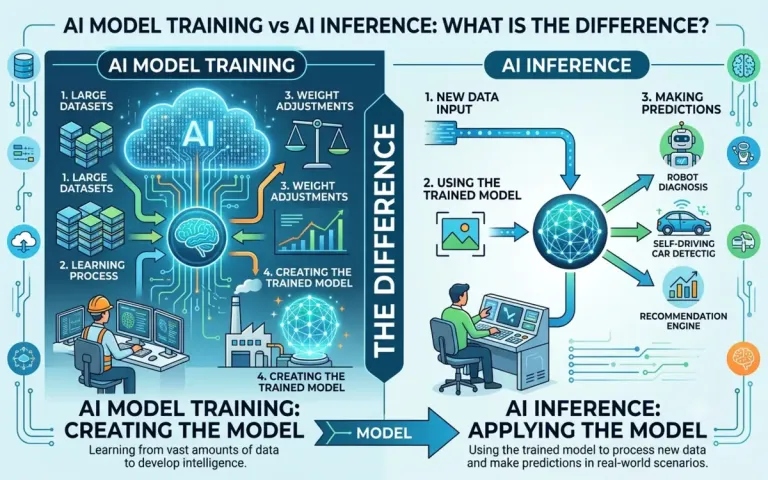
AI training is the process of teaching a model to learn patterns from data, while AI inference is the process of using that trained model to generate predictions, decisions, or responses from new data.
For example, when an AI model is developed by processing millions of text documents, images, or other data, that process is training. When a user subsequently enters a prompt and the trained model generates an answer, that is inference.
Understanding AI training versus inference is important for students, developers, business professionals, and organizations because the two processes have different requirements for data, computing power, infrastructure, cost, speed, and optimization.
What Is AI Model Training?
AI model training is the process through which an artificial intelligence or machine learning model learns patterns and relationships from data.
During training, the model receives data and attempts to produce an appropriate output. Its prediction is compared with the expected result, and the difference is measured using a loss function.
The model then adjusts its internal parameters to improve its future predictions.
In simple terms:
AI training teaches a model how to perform a particular task.
For example, imagine that a company wants to develop an AI model capable of identifying fraudulent transactions.
The organization could provide historical transaction data containing examples of:
Legitimate transactions
Fraudulent transactions
Transaction amounts
Locations
Time of transaction
Customer behavior
Device information
Previous transaction patterns
The model analyzes these examples and gradually learns patterns associated with fraud.
Simplified AI Training Process
The process can be represented as:
Training Data → Model → Prediction → Error/Loss → Parameter Adjustment → Repeat
This cycle is repeated many times until the model reaches an acceptable level of performance.
How Does AI Model Training Work?
Although modern AI training can be highly complex, its basic process can be understood through several steps.
1. Data Collection
The first step is collecting relevant data.
Depending on the application, training data may include:
Text
Images
Audio
Video
Customer records
Financial transactions
Sensor data
Business data
Scientific data
The quality of the training data can significantly affect the quality of the resulting model.
2. Data Preparation
Raw data usually needs to be cleaned and transformed before training.
This may involve:
Removing duplicate records
Correcting errors
Handling missing values
Labeling data
Normalizing numerical values
Tokenizing text
Converting data into appropriate formats
Poor-quality training data can produce poor-quality AI models.
3. Model Processing
The prepared data is passed through the AI model.
The model generates predictions based on its current parameters.
4. Loss Calculation
The prediction is compared with the expected output.
The difference between the prediction and the desired result is represented by a loss function.
A higher loss generally indicates that the model's prediction needs greater improvement.
5. Parameter Adjustment
The model's parameters are adjusted using optimization techniques.
In neural networks, backpropagation and optimization algorithms such as gradient descent are commonly used during this process.
6. Repetition
The training process is repeated across many examples and training cycles.
Over time, the model learns patterns that help it make better predictions on new data.
What Is AI Inference?
AI inference is the process of using a trained AI model to process new input and produce an output.
In simple terms:
Inference is the stage where the trained model applies what it has learned.
For example, suppose a company has trained an AI model to identify fraudulent transactions.
When a new transaction occurs, the transaction information is passed to the trained model.
The model might produce an output such as:
Fraud probability: 92%
Generating this prediction is an example of AI inference.
The simplified process is:
New Input → Trained Model → Output
Examples of AI Inference
Inference occurs whenever a trained AI system processes new information.
Chatbots
A user asks:
"What is market segmentation?"
The AI system processes the prompt and generates an answer.
This response generation is an inference operation.
Image Recognition
A camera sends an image to an AI model.
The model determines:
"Person detected."
This is inference.
Product Recommendations
An e-commerce website analyzes a customer's current behavior and recommends products.
The recommendations are generated through inference.
Fraud Detection
A bank receives a new transaction and uses its trained model to determine whether the transaction appears suspicious.
The prediction occurs during inference.
Voice Recognition
A voice assistant receives spoken input and converts it into text or an appropriate action.
The model's processing of the new audio input involves inference.
AI Model Training vs AI Inference: Key Difference
The fundamental difference can be remembered very easily:
Training = Learning
Inference = Applying
Training changes the model's parameters as it learns from data.
Inference generally uses those existing parameters to process new data and produce an output.
| Feature | AI Model Training | AI Inference |
|---|---|---|
| Main purpose | Teach the model | Use the trained model |
| Data | Training data | New input data |
| Model parameters | Updated | Usually fixed |
| Primary objective | Learn patterns | Generate predictions or outputs |
| Computing requirement | Generally very high | Usually lower per request |
| Frequency | Periodic | Often continuous |
| Latency priority | Less important | Often very important |
| Hardware | GPUs, TPUs, accelerators | CPUs, GPUs, NPUs, accelerators |
| Cost | High development/computing cost | Operational cost at scale |
| Example | Training a fraud detection model | Evaluating a new transaction |
AI Training vs Inference: A Simple Example
Consider an AI system designed to predict whether customers are likely to purchase a product.
During Training
The company provides historical information such as:
Customer age
Previous purchases
Website visits
Products viewed
Time spent on the website
Previous interactions
Purchase history
The model processes many historical examples and learns relationships between customer behavior and purchasing outcomes.
During Inference
A new customer visits the website.
The customer's current information is provided to the trained model.
The model predicts:
Purchase probability = 78%
The prediction is generated during inference.
Therefore:
Historical data + learning = Training
New customer data + trained model = Inference
Why Is AI Training Computationally Expensive?
Training modern AI models can require substantial computational resources.
Large AI models may contain billions of parameters and require enormous datasets.
Training can therefore require:
GPUs
TPUs
AI accelerators
Large amounts of memory
High-speed networking
Large storage systems
Significant electricity
Specialized AI software
Depending on the model and training infrastructure, training can take days, weeks, or even longer.
This is one reason why developing large-scale AI models can be extremely expensive.
Why Is AI Inference Important?
Training creates the model, but inference is what allows the model to provide value in real-world applications.
For example, a company might develop an AI customer-support model.
Once deployed, thousands of customers may interact with it every day.
Every interaction requires the model to process input and generate an output.
Therefore, businesses must consider:
Response time
Infrastructure cost
Scalability
Reliability
Energy consumption
Hardware utilization
Data privacy
This makes inference optimization an important part of AI deployment.
Training vs Inference: Hardware Requirements
Training and inference can use similar types of hardware, but their requirements can be different.
Hardware for AI Training
Large-scale training commonly uses:
GPUs
TPUs
AI accelerators
High-performance computing clusters
Training benefits significantly from parallel computing because large numbers of mathematical operations must be performed repeatedly.
Hardware for AI Inference
Inference can run on:
CPUs
GPUs
TPUs
NPUs
Edge AI processors
Specialized inference accelerators
The appropriate hardware depends on the model's size, complexity, latency requirements, and deployment environment.
Cloud Inference vs Edge Inference
AI inference does not always have to occur in a centralized cloud environment.
It can take place in the cloud or directly on an edge device.
Cloud AI Inference
In cloud inference, input data is sent to a remote server where the AI model processes it.
Advantages
Access to powerful computing resources
Large AI models can be deployed
Centralized management
Easier infrastructure scaling
Centralized model updates
Disadvantages
Requires network connectivity
May introduce network latency
Data privacy considerations
Continuing infrastructure costs
Edge AI Inference
In edge inference, the AI model runs closer to the source of the data.
Examples include:
Smartphones
Security cameras
Vehicles
Industrial machines
IoT devices
Smart appliances
Advantages
Lower latency
Reduced dependence on internet connectivity
Potential privacy benefits
Less data transmission
Disadvantages
Limited computing resources
Hardware constraints
Model-size limitations
More complicated deployment and maintenance
How Are AI Models Optimized for Inference?
A model that performs well during training may still require optimization before being deployed at scale.
Several techniques can improve inference efficiency.
1. Quantization
Quantization reduces the numerical precision used to represent model parameters.
It can reduce:
Memory requirements
Computational requirements
Energy consumption
The challenge is maintaining acceptable model performance while reducing resource requirements.
2. Pruning
Pruning removes parameters or connections that contribute relatively little to the model's performance.
This can make the model smaller and potentially faster.
3. Knowledge Distillation
Knowledge distillation involves training a smaller student model to reproduce useful behavior from a larger teacher model.
The resulting model can sometimes deliver similar performance while requiring fewer resources.
4. Model Compression
Model compression techniques reduce the size and computational requirements of an AI model.
This can be particularly useful when deploying models on resource-constrained devices.
5. Batching
Multiple inference requests can sometimes be processed together.
Batching can improve hardware utilization, although excessive batching may increase response latency.
Does AI Learn During Inference?
Generally, no.
One of the most common misconceptions about AI is that the model automatically learns every time a user interacts with it.
In most deployed AI systems, inference uses the model's existing parameters.
For the model to learn from new data, a separate process may be required, such as:
Retraining
Fine-tuning
Continued training
Model updating
Therefore:
Inference is not the same as training.
An AI system can process millions of requests without changing the underlying model parameters after every request.
Training vs Inference in Generative AI
Generative AI provides a useful example of the difference.
During Training
A large language model can be trained on enormous collections of text and other data.
During this process, the model learns statistical relationships between tokens and patterns in the training data.
Its parameters are adjusted through optimization.
During Inference
A user enters a prompt.
For example:
"Explain the marketing concept in simple terms."
The trained model processes the prompt and generates an answer.
The generation of that answer is inference.
A simplified representation is:
Prompt → Trained Model → Token Generation → Response
What Happens During Large Language Model Inference?
When a user sends a prompt to a large language model, several computational steps occur.
The prompt is converted into tokens.
The tokens are converted into numerical representations.
The model processes the input through its neural network.
The model calculates probabilities for possible next tokens.
A token is selected according to the decoding process.
The selected token becomes part of the sequence.
The process continues until the response is completed.
This process explains why generating longer AI responses can require more computational resources.
AI Training vs Fine-Tuning vs Inference
These three concepts are related but different.
Training
The model learns from a dataset and its parameters are updated.
Fine-Tuning
An already trained model is further trained using a more specific dataset or task.
For example, a general-purpose language model could be fine-tuned for a specialized business application.
Inference
The trained or fine-tuned model is used to process new inputs and generate outputs.
A simplified lifecycle is:
Pretraining → Fine-Tuning → Deployment → Inference
Not every AI system necessarily follows exactly this sequence, but the distinction is useful for understanding AI development.
AI Training vs Inference in Business Applications
The distinction is important across many industries.
| Industry | Training | Inference |
|---|---|---|
| Banking | Learn fraud patterns from historical transactions | Evaluate new transactions |
| Marketing | Learn customer behavior patterns | Predict customer response |
| E-commerce | Learn purchasing patterns | Recommend products |
| Healthcare | Learn patterns from historical data | Analyze new patient data |
| Manufacturing | Learn equipment failure patterns | Analyze live sensor data |
| Cybersecurity | Learn suspicious behavior patterns | Detect potentially malicious activity |
| Education | Learn patterns from historical learning data | Provide personalized recommendations |
Training Cost vs Inference Cost
Training and inference have different cost structures.
Training Cost
Training is usually a large computational investment required to create or improve the model.
Costs can include:
Data preparation
Computing infrastructure
Electricity
Storage
Engineering resources
Model experimentation
Evaluation
Inference Cost
Inference represents the ongoing cost of operating the model.
For example, an AI application serving millions of users may perform an enormous number of inference operations every day.
Therefore:
Training is often a major development expense, while inference can become a major recurring operational expense.
This distinction is especially important when evaluating the economics of AI products.
Which Requires More Computing Power: Training or Inference?
In general, training requires much more computation than a single inference operation because training repeatedly processes large datasets and updates model parameters.
However, inference should not be considered computationally insignificant.
If an AI model serves millions of users, the total inference workload can become enormous.
Therefore:
Training is computationally intensive, while inference can become operationally intensive at scale.
AI Model Training and Inference Lifecycle
Training and inference are components of a broader AI lifecycle.
A simplified lifecycle looks like this:
Data Collection
↓
Data Preparation
↓
Model Training
↓
Model Evaluation
↓
Model Deployment
↓
AI Inference
↓
Monitoring
↓
New Data
↓
Retraining or Model Updating
This shows that AI development is not necessarily a one-time activity.
Models may need to be updated as:
User behavior changes
Business conditions change
New data becomes available
Model performance declines
New risks emerge
Why the Difference Matters for Businesses
Organizations adopting AI should consider training and inference separately.
Training Questions
Businesses should ask:
Do we have sufficient quality data?
Should we train a model from scratch?
Would an existing model be sufficient?
Do we need fine-tuning?
What computing resources are required?
What will model development cost?
Inference Questions
Businesses should ask:
How many users will access the model?
How many requests will be generated?
What response time is required?
Should inference happen in the cloud or at the edge?
How much will model serving cost?
How will the system scale?
How will user data be protected?
Separating these questions can help organizations make better AI investment and deployment decisions.
A Simple Analogy: Student Learning and Examination
The difference between training and inference can be compared with how a student prepares for an examination.
Training
The student:
Reads books
Attends lectures
Studies concepts
Practices questions
Revises information
This resembles AI training.
Inference
During an examination, the student receives a new question and uses previously acquired knowledge to answer it.
This resembles AI inference.
The student does not normally learn the entire subject from scratch while answering each individual question.
Similarly, an AI model generally uses what it learned during training to process new inputs during inference.
Common Misconceptions About AI Training and Inference
1. Inference Means the AI Is Learning
Not necessarily.
Inference generally means applying an already trained model to new input.
2. AI Retrains Every Time We Ask a Question
Usually, no.
Generating a response normally involves inference rather than retraining the model.
3. Inference Is Only Used in Generative AI
No.
Inference is fundamental to machine-learning applications such as:
Classification
Forecasting
Recommendation
Fraud detection
Image recognition
Speech recognition
4. Training Is Always More Expensive Than Inference
Not necessarily when considering the complete operational lifecycle.
Training can be extremely expensive, but inference costs can become substantial when an AI service operates at very large scale.
5. Bigger Models Are Always Better
A larger model may offer greater capabilities in some applications, but it can also require more memory, computation, energy, and infrastructure.
A smaller, optimized model may be more appropriate when speed, cost, or edge deployment is important.
AI Model Training vs AI Inference: Quick Summary
| Question | Training | Inference |
|---|---|---|
| What is it? | Learning from data | Applying learned knowledge |
| Does it change model parameters? | Yes | Usually no |
| What data does it use? | Training data | New input |
| When does it occur? | During model development or updating | During model operation |
| Main goal | Improve model capability | Produce useful outputs |
| Computing demand | Very high | Variable |
| Main concern | Learning accuracy | Speed, cost, scalability |
| Example | Training a fraud model | Checking a new transaction |
Conclusion
AI model training and AI inference are two essential stages in the development and operation of artificial intelligence systems.
Training is the learning phase, where a model processes data and adjusts its parameters to identify patterns and relationships.
Inference is the application phase, where the trained model processes new information and generates predictions, recommendations, classifications, or responses.
The easiest way to remember the difference is:
Training teaches the model; inference uses the model.
The distinction is particularly important as organizations increasingly adopt generative AI, machine learning, cloud AI, and edge AI. While training determines how a model learns and develops its capabilities, efficient inference determines how effectively those capabilities can be delivered to users.
For businesses, understanding both processes is essential for evaluating AI infrastructure, deployment costs, scalability, performance, and overall AI strategy.
Related articles:-
AI Agents vs AI Chatbots: What Is the Difference?
How AI Agents Work: Architecture, Capabilities and Applications
AI Bias: Causes, Examples, Risks and How to Reduce It
Frequently Asked Questions (FAQs)
What is the difference between AI training and AI inference?
AI training is the process of teaching an AI model using data and adjusting its parameters. AI inference is the process of using the trained model to generate predictions or outputs from new input.
Is inference part of AI training?
Inference and training are related but different processes. Training involves learning and parameter updates, while inference generally uses the existing trained parameters to generate outputs.
Is ChatGPT training or inference when answering a question?
When an AI language model generates an answer to a user's prompt, that is generally an inference operation rather than the model being retrained for that individual question.
Which is more computationally expensive, training or inference?
Training is generally much more computationally intensive per model-development cycle. However, inference can become extremely resource-intensive when a model serves millions of users or requests.
Can AI learn during inference?
Normally, inference does not change the model's parameters. Learning from new information generally requires a separate training, fine-tuning, or updating process.
Why is AI inference important for businesses?
Inference determines how efficiently an AI model can deliver predictions or responses to users. Businesses must consider inference speed, infrastructure costs, scalability, reliability, and energy consumption.
What hardware is used for AI inference?
AI inference can use CPUs, GPUs, TPUs, NPUs, and specialized AI accelerators. The appropriate hardware depends on the model and application requirements.
What is edge AI inference?
Edge AI inference occurs when an AI model processes data locally on or near the device where the data is generated, such as a smartphone, camera, vehicle, or IoT device.
Final Takeaway
AI Training = Learning from Data
AI Inference = Applying What Has Been Learned
Understanding this difference provides a foundation for understanding how modern AI systems are developed, deployed, optimized, and operated in real-world business environments.