Introduction
Artificial Intelligence is often described as technology that enables computers to perform tasks associated with human intelligence. But this definition leads to an important question: How does artificial intelligence actually work?
When an AI system recognizes an image, recommends a product, translates a sentence, answers a question, or generates content, it is not thinking in exactly the same way as a human being. Behind the apparent intelligence are computational methods that process data, identify patterns, and generate outputs according to what the system has learned or been designed to do.
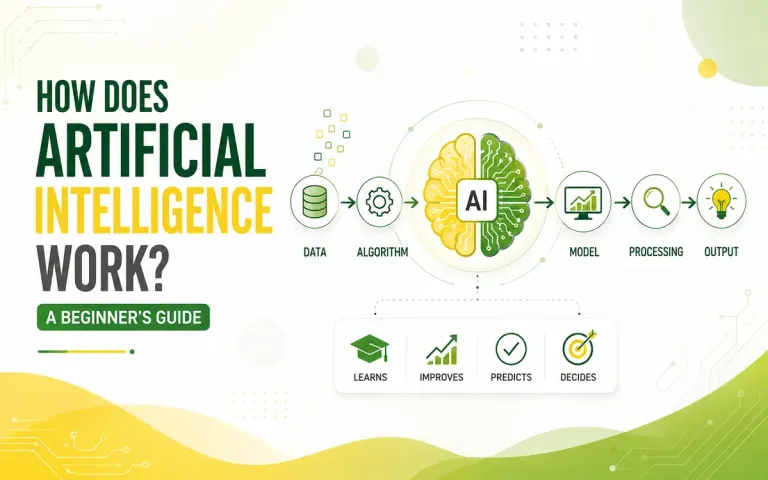
Modern AI systems can be highly sophisticated, but their basic operation can be understood through a relatively simple sequence:
Data → Algorithm → Training → AI Model → Input → Processing → Output
Understanding this process provides a foundation for understanding machine learning, deep learning, generative AI, large language models, and other AI technologies.
What Makes an AI System Different?
Traditional software generally follows instructions explicitly defined by a programmer.
For example, a simple program might be designed with a rule:
If the temperature is above a particular value, display a warning.
The programmer determines the rule and the program follows it.
Many modern AI systems work differently. Instead of manually specifying every possible pattern or situation, developers can train a model using data. The system identifies patterns within that data and uses what it has learned when processing new information.
For example, instead of writing thousands of rules describing what makes an image a cat, a machine-learning system can be trained using many examples of images that have been labeled appropriately.
The system can then use the patterns it learned to estimate whether a new image belongs to that category.
This ability to learn patterns from data is one of the central ideas behind modern AI.
The Basic Components of AI
Although AI systems can be extremely complex, several fundamental components appear repeatedly.
1. Data
Data is one of the most important resources used by modern AI systems.
Depending on the application, data may include:
- Text
- Images
- Audio
- Video
- Numerical records
- Sensor readings
- Transaction information
- User interactions
The type and quality of data required depend on the AI system's purpose.
For example, an image-recognition system needs visual data, while a language model requires large amounts of text and related training information.
Poor-quality, incomplete, biased, or inappropriate data can affect the resulting system.
2. Algorithms
An algorithm is a defined computational method for processing information or solving a problem.
In machine learning, algorithms are used to enable a system to learn patterns from data and improve its performance according to a particular objective.
Different problems require different approaches.
For example, an algorithm used to classify images may be different from one used to predict customer demand.
Algorithms therefore provide the computational procedures through which data can be transformed into useful patterns or predictions.
3. AI Models
An AI model is a computational model that has been developed or trained to perform a particular task or set of tasks.
In machine learning, the model learns patterns from training data.
Once trained, it can process new inputs.
For example:
Training data: Many examples of emails labeled as spam or legitimate
↓
Learning process
↓
Trained model
↓
New email
↓
Model estimates whether it is spam
The model does not simply memorize one answer for every possible future situation. Ideally, it learns patterns that allow it to generalize to new examples.
4. Computing Power
Modern AI systems can require substantial computing resources.
Training sophisticated models may involve processing enormous quantities of data and performing very large numbers of mathematical calculations.
Specialized hardware, cloud computing infrastructure, and other technologies help make these calculations possible.
Computing power is particularly important for large machine-learning and deep-learning systems.
How AI Learns From Data
The concept of learning is central to many modern AI systems.
Consider an organization that wants to develop a system capable of identifying fraudulent transactions.
Developers could provide the system with historical transaction data containing examples of legitimate and fraudulent transactions.
The learning process attempts to identify patterns associated with the available examples.
These patterns could involve combinations of factors such as transaction characteristics, timing, frequency, location, or other relevant variables.
The resulting model can then be evaluated using data it has not previously seen.
If its performance is inadequate, the model or training process may be adjusted.
This illustrates an important point:
AI does not automatically learn correctly simply because large amounts of data are provided.
The quality of the data, choice of algorithm, training process, evaluation methods, and design of the system all matter.
What Is Machine Learning?
Machine Learning (ML) is one of the most important approaches used in modern artificial intelligence.
Instead of programming every rule explicitly, machine-learning systems use data to identify patterns and relationships that can be used for prediction, classification, recommendation, or other tasks.
Common broad categories of machine learning include:
Supervised Learning
The model learns from examples where the desired outcome is already known.
For example, historical customer records may be labeled according to whether a customer made a purchase.
Unsupervised Learning
The system attempts to discover patterns or structures in data without being given predefined output labels.
For example, it may identify groups of customers with similar characteristics.
Reinforcement Learning
A system learns through interaction with an environment, receiving rewards or penalties associated with different actions.
This approach has been used in areas such as game-playing systems and certain control problems.
Machine learning is a major part of AI, but AI and machine learning are not synonymous. This distinction will be explored in greater detail in the next article of this series.
Training an AI Model
Training is the process through which a machine-learning model learns patterns from data.
A simplified training process looks like this:
Training Data
↓
Algorithm processes the data
↓
Model generates an output
↓
Output is compared with the desired result or evaluation objective
↓
Model parameters are adjusted
↓
Process is repeated
Through repeated optimization, the model attempts to improve its performance on the task for which it is being trained.
The actual mathematics behind this process can be highly complex, particularly for deep-learning systems. However, the fundamental idea is relatively straightforward: the model adjusts itself based on information from the training process.
How an AI Model Produces an Output
After training, an AI model can process new information.
This stage is commonly referred to as inference.
A simplified process is:
New Input → Trained Model → Processing → Output
For example, consider an image-classification system.
A user provides an image.
The system processes the image and compares its learned patterns with the characteristics present in the new input.
It then produces an output such as a predicted category.
Similarly, a language model receives text as input and processes patterns learned during training to generate a response.
The important point is that training and inference are different stages.
Training develops the model.
Inference uses the resulting model.
What Are Neural Networks?
Neural networks are computational models inspired loosely by the structure of biological neural systems.
They consist of interconnected computational units organized into layers.
A simplified neural network contains:
- An input layer
- One or more intermediate layers
- An output layer
Information moves through these layers, with mathematical operations transforming the input as it progresses.
Neural networks can learn complex relationships between inputs and outputs by adjusting internal parameters during training.
They are particularly important in modern AI applications involving:
- Images
- Speech
- Natural language
- Video
- Complex pattern recognition
How Deep Learning Works
Deep learning is a form of machine learning based on neural networks with multiple layers.
The additional layers allow deep-learning models to represent increasingly complex patterns.
For example, in an image-related task, earlier layers may identify relatively simple visual features, while deeper layers can combine those features into more complex representations.
Deep learning has contributed significantly to advances in areas such as computer vision, speech recognition, natural language processing, and generative AI.
However, deep-learning systems can require substantial amounts of data, computing resources, and careful training.
How Generative AI Produces Content
Generative AI uses models capable of producing new outputs based on patterns learned during training.
Depending on the model, the output may be:
- Text
- Images
- Audio
- Video
- Code
A simplified representation is:
User Prompt → Generative AI Model → Processing → Generated Output
For example, when a user enters a question into a generative AI system, the system processes the input and generates an output based on patterns represented within its model.
The result can appear remarkably human-like, but this does not mean that the system possesses human consciousness or understanding in the same sense as a person.
Generative AI will be examined more closely in a later article in this series.
A Simple Example of How AI Works
Consider a recommendation system used by an online shopping platform.
The system may have access to information about:
- Products
- Previous purchases
- Searches
- Browsing behavior
- Product interactions
An AI or machine-learning model can analyze patterns in this information.
Suppose users who purchase Product A frequently also purchase Product B.
After analyzing sufficient data, the system may identify a relationship between these products.
When another customer shows interest in Product A, the system can use the learned patterns to recommend Product B.
The simplified process is:
Data → Learning → Model → Customer Input → Prediction/Recommendation → Result
This example demonstrates how AI can transform large amounts of data into useful predictions or recommendations.
Why AI Can Make Mistakes
An AI system can produce incorrect results even when it is highly sophisticated.
There are several possible reasons.
Poor or Incomplete Data
If the training data is inadequate or does not adequately represent the situations encountered later, performance may suffer.
Bias in Data
Patterns in the training data can influence model behavior. If the data contains undesirable biases, the resulting system may reproduce or amplify them.
Model Limitations
Every model has limitations. A system designed for one type of task may perform poorly outside its intended context.
Unexpected Inputs
AI systems can encounter situations that differ significantly from those represented during development or training.
Generative AI Errors
Generative AI systems can sometimes produce plausible-sounding but incorrect information. Users should therefore verify important claims rather than assuming that fluent output is automatically accurate.
The Role of Humans in AI
Although AI can automate many tasks, humans remain important throughout the AI lifecycle.
People are involved in:
- Defining objectives
- Collecting and preparing data
- Designing systems
- Training and evaluating models
- Monitoring performance
- Interpreting results
- Managing risks
- Making important decisions
For high-stakes applications, human oversight is particularly important.
The most effective use of AI is therefore often not simply human versus machine, but human expertise supported by appropriate AI capabilities.
Related articles:-
How Generative AI is Transforming Digital Marketing Strategies
AI Integration in Business: Opportunities and Challenges
10 Game-Changing AI Tools Revolutionizing Business in 2025
How AI Is Transforming Strategic Decision-Making for Small Businesses in 2026
Top 5 AI Tools Every Small Business Should Use in 2025
Conclusion
Artificial Intelligence can appear complex because modern AI systems contain sophisticated algorithms, mathematical models, neural networks, and large-scale computing infrastructure. However, its basic operation can be understood through a relatively simple framework.
Data provides information. Algorithms provide computational methods. Training allows models to learn patterns. Inference allows trained models to process new inputs and generate outputs.
This framework provides the foundation for understanding many modern AI technologies.
However, AI is a broad field, and different approaches are used for different purposes. Machine learning represents one of the most important approaches within AI, while deep learning represents a major branch of machine learning.
Understanding these relationships is essential for developing meaningful AI literacy.
The following article will examine one of the most common sources of confusion in AI:
Machine Learning vs Artificial Intelligence: What Is the Difference?
Artificial Intelligence: A Complete Guide to AI, Its Types, Applications, and Impact
Frequently Asked Questions
How does Artificial Intelligence work?
AI systems process data using algorithms and computational models. In many modern systems, models learn patterns from data during training and then use those learned patterns to process new inputs and generate predictions, classifications, recommendations, or other outputs.
Does all AI use machine learning?
No. Machine learning is a major approach to AI, but AI can also involve other methods, including rule-based systems and symbolic approaches.
What is AI training?
Training is the process through which a machine-learning model learns patterns from data and adjusts its internal parameters to improve its performance.
What is AI inference?
Inference is the process of using a trained AI model to process new input and produce an output.
What is a neural network?
A neural network is a computational model consisting of interconnected layers of computational units that can learn complex patterns from data.
Why does AI sometimes give incorrect answers?
AI systems can make mistakes because of limitations in their training data, model design, inputs, or ability to generalize. Generative AI can also produce plausible but inaccurate information, so important outputs should be verified.