Introduction
Implementing a payment gateway on a website involves more than simply connecting an API and accepting online payments. Because payment integrations handle sensitive information, transaction data, authentication credentials, and financial records, security must be treated as a fundamental part of the integration architecture.
A secure payment integration protects both the website owner and customers from data theft, payment fraud, unauthorized transactions, API abuse, and other cyber threats.
Below are the key security measures you should implement when integrating a payment gateway such as Razorpay, Stripe, PayPal, or another payment service into your website.
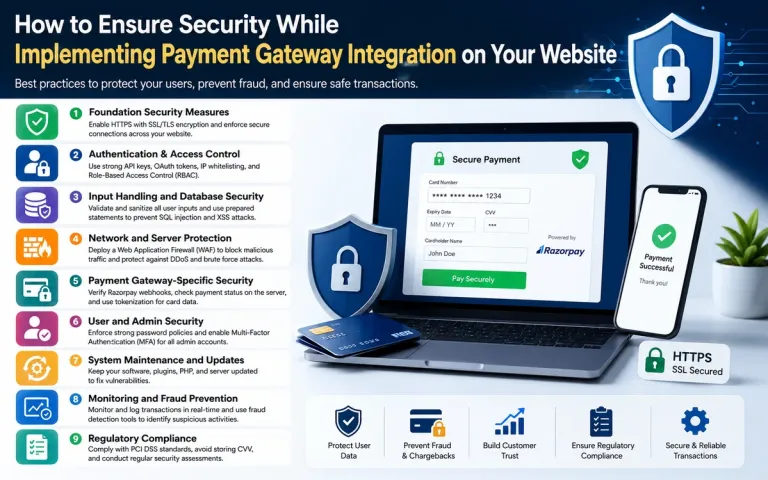
1. Foundation Security Measures
Enable HTTPS with SSL/TLS Encryption
HTTPS should be mandatory for every website that processes payments or handles user accounts.
Install and maintain a valid SSL/TLS certificate on your server.
Redirect all HTTP requests to HTTPS.
Ensure that payment-related pages, checkout pages, login pages, and API endpoints are accessible only through HTTPS.
Use secure TLS configurations and avoid outdated encryption protocols.
Ensure that sensitive information is never transmitted through unencrypted HTTP connections.
HTTPS encrypts communication between the user's browser and your website, reducing the risk of attackers intercepting sensitive information.
However, HTTPS alone does not make a payment integration secure. Application-level security, authentication, server security, and proper payment verification are equally important.
2. Authentication & Access Control
Secure Authentication & Authorization
Payment gateway credentials are highly sensitive and should be protected like passwords.
Never expose API keys, API secrets, webhook secrets, database credentials, or other confidential credentials in:
Front-end JavaScript
HTML source code
Public GitHub repositories
URLs or query strings
Client-side applications
Public configuration files
Keep secret credentials on the server side and load them through secure environment variables or protected configuration mechanisms.
Where supported, use appropriate authentication mechanisms such as API keys, OAuth tokens, or signed requests.
You should also:
Use separate credentials for test and production environments.
Apply the principle of least privilege.
Restrict administrative access to authorized personnel.
Implement Role-Based Access Control (RBAC) where multiple users have different administrative responsibilities.
Rotate compromised or exposed credentials immediately.
IP allowlisting can provide an additional layer of protection for selected server-to-server APIs, although it should not be considered a replacement for proper authentication.
3. Input Handling and Database Security
Validate & Sanitize User Inputs
Payment systems frequently interact with customer information, product details, quantities, prices, order IDs, and transaction information. Improperly validated input can create vulnerabilities such as SQL injection, cross-site scripting (XSS), and parameter manipulation.
Validate all data received from users and external requests on the server side.
Use:
Prepared statements or parameterized queries for database operations.
Server-side validation for amounts, quantities, identifiers, and transaction parameters.
Output encoding to reduce XSS risks.
Whitelisting where possible instead of accepting arbitrary input.
Appropriate length and format restrictions.
Never rely exclusively on client-side validation because an attacker can modify browser requests before they reach your server.
Most importantly, never trust the payment amount received from the browser. The server should determine the actual payable amount from trusted product, order, or database records.
4. Network and Server Protection
Deploy a Web Application Firewall (WAF)
A Web Application Firewall can provide an additional security layer between your website and malicious traffic.
A WAF can help detect or block common attacks such as:
SQL injection attempts
Cross-site scripting
Malicious HTTP requests
Automated attacks
Brute-force attempts
Certain forms of bot and DDoS traffic
You can use security features provided by your hosting provider, such as Hostinger's available security mechanisms, or use an appropriate cloud-based security service.
However, a WAF should complement—not replace—secure application development.
You should also:
Keep unnecessary ports and services closed.
Restrict server access where possible.
Use secure file and directory permissions.
Disable unnecessary PHP extensions and services.
Monitor server logs for suspicious activity.
Maintain reliable backups.
5. Payment Gateway-Specific Security
Secure Razorpay Webhooks
Webhooks allow a payment gateway to notify your application about events such as successful payments, refunds, or other transaction-related activities.
Because webhook requests originate outside your application, never automatically trust an incoming webhook.
For Razorpay, verify the webhook signature using the webhook secret configured for your application.
A secure webhook implementation should:
Receive the webhook request.
Read the original request payload exactly as required by the gateway.
Verify the webhook signature using the configured webhook secret.
Reject requests that fail signature verification.
Process only recognized and valid events.
Prevent the same event from being processed repeatedly.
Webhook verification is particularly important because an attacker could otherwise attempt to send a forged request to your payment endpoint and falsely mark an order as paid.
Verify Payment Status on the Server
Do not treat a browser redirect or client-side success message as sufficient evidence that a payment was completed.
After the payment process, your server should verify the transaction using the payment gateway's recommended server-side verification mechanism.
For example, your application should validate relevant transaction identifiers, signatures, order references, and payment status before updating the order as paid.
The fundamental principle is:
Never grant the product, service, download, or other benefit solely because the browser says that payment was successful.
Implement Tokenization for Card Data
Your website should avoid handling or storing raw card information unless your payment architecture and compliance requirements specifically require it.
When supported by the payment provider, tokenization allows sensitive payment information to be represented by a token rather than being directly stored by your application.
In a typical hosted checkout or gateway-managed payment flow:
Customer → Payment Gateway → Payment Result → Your Server
rather than:
Customer → Your Server → Raw Card Data
This significantly reduces the amount of sensitive payment data that your own infrastructure needs to handle.
Never store CVV/CVC numbers or other prohibited sensitive authentication data in your database.
6. User and Admin Security
Enforce Strong Password Policies
Payment administration systems should receive stronger security controls than ordinary website accounts because unauthorized administrative access could result in financial and data-related consequences.
Implement:
Strong password requirements.
Secure password hashing using modern password-hashing algorithms.
Multi-Factor Authentication (MFA) for administrator and privileged accounts.
Login rate limiting.
Account lockout or additional verification after suspicious login attempts.
Secure session management.
Automatic session expiration where appropriate.
Administrative accounts should be limited to the minimum privileges required for their responsibilities.
Never use shared administrator credentials when individual accounts can be provided.
7. System Maintenance and Updates
Keep Software and Plugins Updated
Security is not a one-time implementation task. Vulnerabilities can be discovered after your payment integration has already been deployed.
Regularly update:
PHP
MySQL or other database software
Operating system components
Frameworks
CMS platforms
Payment gateway SDKs
Third-party libraries
Plugins and dependencies
Remove outdated or unused software components whenever possible.
Before applying major updates to a production payment system, test them in a development or staging environment to avoid introducing compatibility problems.
8. Monitoring and Fraud Prevention
Monitor and Log Transactions
Security monitoring helps identify suspicious activity that may not be visible during normal payment processing.
Maintain appropriate logs for:
Payment attempts
Successful and failed transactions
Refunds
Webhook events
Authentication failures
Administrative activities
API errors
Suspicious requests
Logs should not contain sensitive information such as card numbers, CVV/CVC values, API secrets, or passwords.
Use monitoring and fraud-prevention mechanisms provided by your payment gateway where available. Watch for unusual patterns such as repeated failed payments, abnormal transaction frequencies, unexpected refund activity, or attempts to manipulate transaction parameters.
For higher-risk applications, additional controls such as rate limiting, transaction limits, velocity checks, and risk-based verification can provide further protection.
9. Regulatory Compliance
Comply with PCI DSS Standards
Payment security also involves regulatory and industry requirements.
The Payment Card Industry Data Security Standard (PCI DSS) establishes security requirements for organizations involved in payment card processing.
The exact compliance responsibilities depend on your payment architecture and the way your website handles cardholder data.
Using a gateway's hosted checkout or other gateway-managed payment mechanism can reduce the amount of cardholder data handled directly by your infrastructure, but it does not automatically eliminate all security or compliance responsibilities.
Therefore:
Do not store CVV/CVC numbers.
Avoid storing raw card details unless there is a legitimate and compliant requirement.
Protect payment-related credentials.
Restrict access to payment systems.
Maintain appropriate security controls and monitoring.
Review the payment provider's current integration and compliance requirements.
Regularly assess your application's security.
For businesses handling significant payment volumes or sensitive information, professional security and compliance assessment may be appropriate.
Discover also:-
Cybersecurity Strategies for Tech-Driven Enterprises
Cybersecurity Compliance for Modern Enterprises: What You Must Know
Conclusion
Securing a payment gateway integration requires a multi-layered security approach rather than a single security mechanism.
HTTPS protects data in transit, authentication protects APIs and administrative functions, input validation protects the application, secure database practices protect stored information, webhook and payment verification prevent fraudulent transaction confirmation, and monitoring helps detect suspicious activity.
A secure architecture can be summarized as:
HTTPS → Secure Credentials → Server-Side Validation → Secure Payment Processing → Signature/Webhook Verification → Payment Status Verification → Protected Database → Monitoring & Fraud Prevention
The most important principle is to never trust client-side payment information without server-side verification.
By implementing these security measures from the beginning, website owners can significantly reduce the risk of payment fraud, unauthorized access, data breaches, and transaction manipulation while providing customers with a safer online payment experience.