Introduction
Artificial Intelligence (AI) and Machine Learning (ML) are among the most frequently used terms in modern technology. They are often used interchangeably, but they do not mean exactly the same thing.
The confusion is understandable because machine learning is one of the most important approaches used to develop modern AI systems. Deep learning is then a specialized approach within machine learning, while neural networks are an important technology used in many deep-learning systems.
Understanding these relationships is important for anyone who wants to develop a practical understanding of modern AI.
The simplest way to remember the relationship is:
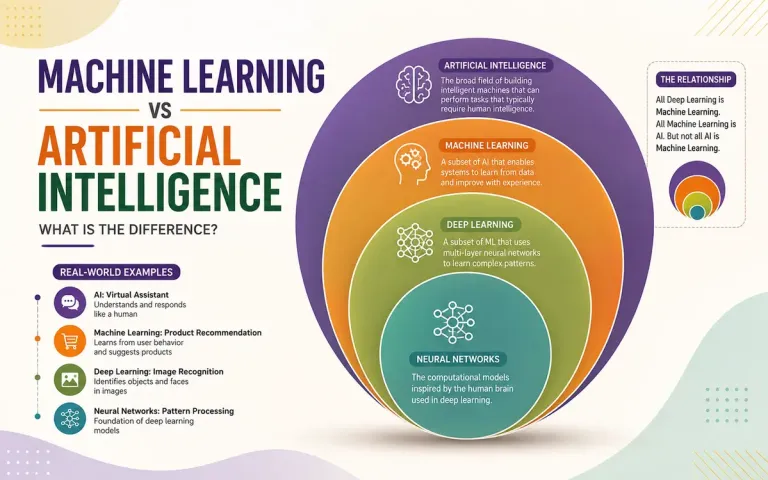
Artificial Intelligence → Machine Learning → Deep Learning → Neural Networks
However, this is a simplified representation. AI is a broader field, and not every AI system necessarily uses machine learning or deep learning.
What Is Artificial Intelligence?
Artificial Intelligence is a broad field of computer science concerned with developing systems capable of performing tasks associated with aspects of intelligent behavior.
These tasks may include:
Understanding language
Recognizing patterns
Solving problems
Making predictions
Processing images
Supporting decisions
Generating content
Interacting with users
AI therefore represents the broader objective of creating computational systems capable of performing tasks that can appear intelligent.
For example, a system that recommends products to customers, recognizes objects in an image, or responds to natural-language questions may be considered an AI application.
AI can be developed using different approaches, including rule-based systems, machine learning, deep learning, and other computational techniques.
What Is Machine Learning?
Machine Learning is a major approach within Artificial Intelligence in which systems learn patterns from data and use those patterns to make predictions, classifications, recommendations, or other decisions.
Instead of explicitly programming every possible rule, developers provide data and an appropriate learning method that allows a model to identify useful patterns.
For example, consider a system designed to identify spam emails.
Instead of manually creating rules for every possible spam message, developers can train a machine-learning model using examples of emails that have already been classified as spam or legitimate.
The model learns patterns associated with the examples and can then evaluate new emails.
The basic concept can be represented as:
Data → Learning Process → Model → New Input → Prediction
Machine learning is therefore not separate from AI. It is one of the major ways in which AI capabilities are developed.
AI vs Machine Learning
The key difference is scope.
Artificial Intelligence is the broader field.
Machine Learning is a method used within that field.
A useful analogy is:
AI is the broader objective, while machine learning is one of the important approaches used to achieve that objective.
For example, an organization may want to build an intelligent customer-support system.
The overall objective of creating an intelligent system belongs to AI.
If the system learns from historical customer interactions to classify questions or predict appropriate responses, machine learning may be used to achieve part of that objective.
Therefore:
AI is broader than Machine Learning.
What Is Deep Learning?
Deep Learning is a specialized form of Machine Learning that uses neural networks with multiple computational layers to learn complex patterns from data.
Deep learning has become particularly important because it has enabled significant progress in areas such as:
Image recognition
Speech recognition
Natural language processing
Computer vision
Generative AI
Deep-learning models can process large and complex datasets and learn representations that may be difficult to develop using simpler machine-learning approaches.
The relationship can therefore be represented as:
Artificial Intelligence
↓
Machine Learning
↓
Deep Learning
Deep learning is therefore a subset of machine learning, which itself is a major subset or approach within AI.
What Are Neural Networks?
A neural network is a computational model consisting of interconnected units organized into layers.
The terminology is inspired loosely by biological neural systems, but artificial neural networks are mathematical and computational systems rather than artificial versions of the human brain.
A simplified neural network contains:
Input Layer → Hidden Layers → Output Layer
During training, the network adjusts internal parameters to improve its performance on a particular task.
Neural networks are widely used in deep learning.
For example, a neural network trained on images may learn increasingly complex visual patterns through its layers.
A simplified progression might look like:
Basic visual features → shapes and patterns → complex structures → classification
Modern neural networks can contain very large numbers of parameters and can be trained using substantial computational resources.
Understanding the Relationship
The relationship between these concepts can be illustrated using a simple hierarchy:
Artificial Intelligence
The broad field concerned with intelligent computational systems.
↓
Machine Learning
An approach in which systems learn patterns from data.
↓
Deep Learning
A specialized machine-learning approach using multi-layered neural networks.
↓
Neural Networks
Computational architectures used in machine learning, particularly deep learning.
This hierarchy helps explain why the terms are related but should not be treated as synonyms.
A Simple Real-World Example
Consider a facial-recognition system.
The overall objective of building a system capable of recognizing people from images can be considered an AI application.
A machine-learning approach can be used to train the system using examples of images.
A deep-learning approach may use a multi-layer neural network to learn complex visual patterns.
The neural network processes features in the images and produces an output associated with the recognition task.
Therefore, the same application can involve all four concepts at different levels:
AI: The broader intelligent application
Machine Learning: Learning from examples
Deep Learning: The specific learning approach
Neural Network: The computational architecture
Traditional AI Without Machine Learning
It is important not to assume that every AI system uses machine learning.
Some AI systems can operate using explicitly defined rules and logic.
For example, a simple rule-based system might operate according to instructions such as:
IF a particular condition is satisfied
THEN perform a specified action.
Such systems can be useful for clearly defined problems where the rules are known in advance.
Machine learning becomes particularly valuable when manually defining all relevant rules is difficult and patterns need to be learned from data.
This distinction also explains why AI should not simply be defined as "machines learning from data."
AI is a broader field.
Machine Learning Approaches
Machine learning itself contains several approaches.
Supervised Learning
The model learns from labeled examples where the desired outcome is known.
For example, a dataset may contain customer records labeled according to whether customers purchased a product.
Unsupervised Learning
The system searches for patterns or structures within data without predefined output labels.
For example, it can be used to identify groups of customers with similar characteristics.
Reinforcement Learning
A system learns through interaction with an environment and receives feedback associated with its actions.
This approach can be useful for certain sequential decision-making problems.
These approaches demonstrate that machine learning itself is a broad field containing different methods.
Why the Distinction Matters
Understanding the difference between AI and machine learning is more than a matter of terminology.
It helps organizations and individuals make better technology decisions.
A business considering an AI solution needs to understand:
What problem needs to be solved?
Is machine learning actually required?
What type of data is available?
What level of accuracy is necessary?
What risks are involved?
How will the system be evaluated?
Where is human oversight required?
Using the term "AI" for every technology can hide important differences in how systems actually work.
Understanding the underlying technology helps decision-makers evaluate AI solutions more realistically.
AI, Machine Learning, and Generative AI
Generative AI has added another layer to the terminology.
Generative AI refers to AI systems capable of producing new content such as text, images, audio, video, or code.
Many modern generative AI systems use deep-learning architectures and are trained using large datasets.
Large language models are an important example.
The relationship can therefore extend beyond the basic hierarchy:
Artificial Intelligence
→ Machine Learning
→ Deep Learning
→ Neural Networks
And within modern AI applications:
Deep Learning → Generative AI → Large Language Models and other generative systems
These relationships will become clearer as we explore generative AI and large language models in later articles.
Key Differences at a Glance
| Concept | Meaning | Main Role |
|---|---|---|
| Artificial Intelligence | Broad field of intelligent computational systems | Overall field |
| Machine Learning | Systems learn patterns from data | Learning approach |
| Deep Learning | Machine learning using multi-layer neural networks | Advanced learning approach |
| Neural Networks | Computational models consisting of interconnected layers | Model architecture |
The boundaries can become more nuanced in advanced technical contexts, but this framework is sufficient for understanding the basic relationship between the concepts.
Conclusion
Artificial Intelligence, Machine Learning, Deep Learning, and Neural Networks are closely related but represent different concepts.
Artificial Intelligence is the broad field.
Machine Learning is a major approach within AI that allows systems to learn patterns from data.
Deep Learning is a specialized form of machine learning based on multi-layer neural networks.
Neural Networks are computational architectures used in many machine-learning and deep-learning systems.
Understanding this relationship provides an important foundation for exploring modern AI technologies.
As AI continues to develop, concepts such as Generative AI, Large Language Models, multimodal systems, and AI agents are becoming increasingly important.
Related readings:-
How Does Artificial Intelligence Work? A Beginner's Guide
Artificial Intelligence: A Complete Guide to AI, Its Types, Applications, and Impact
The next article in this series will focus on one of these major developments:
What Is Generative AI? How It Works and Where It Is Used