Introduction
Creating high-quality content and optimizing your webpages are essential components of a successful SEO strategy. However, even the best content may struggle to achieve strong visibility if search engines have limited evidence that the website is trustworthy, authoritative, and recognized by others.
This is where Off-Page SEO becomes important.
Off-page SEO refers to activities and signals that occur outside your website but influence how search engines evaluate its credibility and relevance. Rather than focusing on the structure or content of individual webpages, off-page SEO is concerned with building your website's reputation through external recognition.
For example, if several reputable websites reference one of your articles because they find it useful, those references can serve as signals that your content is valuable. Likewise, when people discuss your brand online or share your content across different platforms, your website's visibility and reputation may gradually grow.
In this guide, you will learn what off-page SEO is, why it matters, the factors that contribute to it, ethical link-building techniques, and practical strategies for strengthening your website's authority over time.
What Is Off-Page SEO?
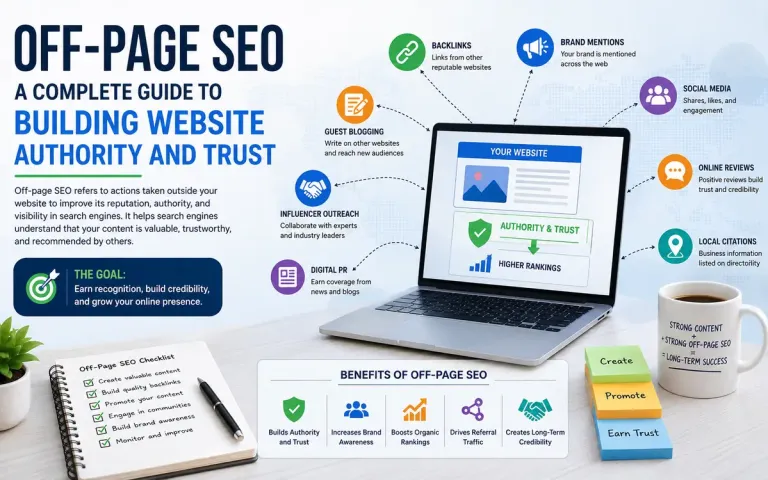
Off-page SEO refers to optimization activities that take place outside your website and help improve its authority, credibility, reputation, and potential visibility in search engine results.
Unlike on-page SEO, where you optimize content and webpage elements directly, off-page SEO focuses on how other websites, organizations, and users interact with and recognize your content.
Common off-page SEO activities include:
- Earning backlinks from reputable websites
- Building brand awareness
- Digital public relations (Digital PR)
- Social media promotion
- Guest blogging
- Online community participation
- Local business citations
- Managing online reviews
- Influencer collaborations
The primary objective is to demonstrate that your website is a trustworthy source of information within its field.
Why Is Off-Page SEO Important?
Off-page SEO helps establish credibility beyond your own website.
Its benefits include:
Building Website Authority
External recognition from relevant and trustworthy websites can strengthen your website's perceived authority.
Increasing Brand Awareness
When your content is shared across multiple platforms, more people become familiar with your website and brand.
Supporting Organic Visibility
Search engines consider many signals when evaluating webpages. External references can contribute to their overall understanding of a website's reputation.
Driving Referral Traffic
Visitors may discover your content directly from links on other websites, blogs, forums, or social platforms.
Building Trust
Recommendations from respected organizations or industry publications can increase confidence in your content.
On-Page SEO vs Off-Page SEO
| On-Page SEO | Off-Page SEO |
|---|---|
| Optimizes your website | Builds authority outside your website |
| Content quality | Backlinks |
| Titles and headings | Brand mentions |
| Internal links | Digital PR |
| Meta descriptions | Reviews and citations |
| User experience | Social engagement |
Both approaches complement one another. Excellent off-page SEO cannot compensate for poor content, and excellent content often benefits from external recognition.
Understanding Website Authority
Website authority is not a single official ranking score published by search engines. Instead, it refers broadly to the credibility and trustworthiness that a website earns over time through consistent quality and recognition.
Authority develops when:
- Content is useful and accurate.
- Other reputable websites reference your pages.
- Users engage positively with your content.
- Your website demonstrates expertise within its niche.
Authority is built gradually rather than instantly.
What Are Backlinks?
A backlink is a hyperlink from one website to another.
For example:
Website A → Links to → Website B
When another website links to one of your pages, it creates a backlink.
Backlinks help users discover additional information and may also help search engines understand relationships between websites.
However, the value of a backlink depends on factors such as relevance, quality, and context rather than quantity alone.
Types of Backlinks
Natural Backlinks
Natural backlinks are earned because another website genuinely finds your content useful and chooses to reference it without being asked.
Example:
A university links to your article explaining digital marketing concepts because it is useful for students.
Manual Backlinks
Manual backlinks are acquired through legitimate outreach and relationship building.
Examples include:
- Guest articles
- Resource page submissions
- Professional collaborations
- Industry partnerships
Self-Created Links
These are links that website owners create themselves through profile pages, forums, or comments.
They generally provide limited SEO value and should be used responsibly rather than excessively.
Characteristics of High-Quality Backlinks
Not all backlinks have the same value.
Generally, a valuable backlink is:
- Relevant to your topic
- From a trustworthy website
- Editorially placed
- Contextually related to the content
- Natural rather than manipulated
A single relevant backlink from a respected industry publication may be more valuable than numerous low-quality links.
Anchor Text
Anchor text is the clickable text within a hyperlink.
Examples:
Good:
Learn more about keyword research.
Weak:
Click here
Descriptive anchor text helps users understand the destination page and provides useful context.
Link Attributes
Some hyperlinks include attributes that indicate how they should be interpreted.
Follow Links
Standard links that allow search engines to discover connected pages.
Nofollow Links
Indicate that the linking website does not intend to pass certain ranking signals through the link.
Sponsored Links
Used when links are part of advertising or sponsorship arrangements.
User-Generated Content (UGC)
Used for links created by users in comments, forums, or community discussions.
These attributes contribute to transparency regarding the nature of links.
Digital PR
Digital Public Relations (Digital PR) focuses on earning media coverage, mentions, and editorial links by creating newsworthy or valuable content.
Examples include:
- Original research
- Industry reports
- Surveys
- Expert interviews
- Infographics
- Case studies
Digital PR aims to attract attention because the content is genuinely useful or interesting.
Brand Mentions
A brand mention occurs when another website references your business or brand, whether or not it includes a hyperlink.
Examples:
- Blog articles
- Online news
- Podcasts
- Industry publications
- Social media discussions
Consistent brand mentions can contribute to broader online visibility.
Social Media and Off-Page SEO
Social media platforms are valuable for distributing content and increasing brand awareness.
Although social media activity is not generally considered a direct ranking factor, it can:
- Increase content visibility
- Generate referral traffic
- Encourage sharing
- Build professional relationships
- Attract natural backlinks
For example, publishing your SEO articles on LinkedIn, Facebook, and X can expose them to audiences who may later reference them.
Guest Blogging
Guest blogging involves writing articles for another relevant website.
Benefits include:
- Reaching new audiences
- Demonstrating expertise
- Building professional relationships
- Earning editorial backlinks where appropriate
Guest articles should provide genuine value rather than exist solely to obtain links.
Online Communities
Participating in professional communities can increase visibility.
Examples include:
- Industry forums
- Professional discussion groups
- Question-and-answer platforms
- Research communities
The focus should be on providing helpful contributions rather than promoting your website excessively.
Local SEO and Citations
For businesses serving specific geographic areas, citations can support local visibility.
A citation generally includes:
- Business name
- Address
- Phone number
Consistency across directories is important.
Online Reviews
Customer reviews influence trust and reputation.
Encourage genuine reviews from satisfied customers without offering incentives or manipulating ratings.
Respond professionally to both positive and constructive feedback.
Influencer and Industry Collaboration
Collaborating with experts, educators, or industry professionals can expand your audience.
Examples include:
- Interviews
- Joint webinars
- Research collaborations
- Podcasts
- Expert roundups
These collaborations often generate valuable exposure.
Link Building Strategies
Ethical link-building methods include:
Create Exceptional Content
People naturally reference content that is informative, original, or solves a problem.
Publish Original Research
Research reports and surveys often attract citations.
Create Useful Resources
Examples include:
- Checklists
- Templates
- Calculators
- Infographics
- Free tools
Broken Link Building
Identify broken links on relevant websites and suggest your own appropriate replacement content.
Resource Pages
Many websites maintain collections of useful resources.
If your content genuinely fits, you can suggest it for inclusion.
Guest Contributions
Write high-quality articles for reputable websites within your niche.
Practices to Avoid
Avoid techniques intended to manipulate search rankings, such as:
- Buying backlinks
- Participating in link schemes
- Automated link creation
- Private blog networks (PBNs)
- Excessive directory submissions
- Comment spam
- Keyword-rich spammy anchor text
These practices can damage your website's reputation.
Measuring Off-Page SEO Success
Useful indicators include:
- Number of referring domains
- Quality of backlinks
- Referral traffic
- Brand mentions
- Organic traffic growth
- Keyword visibility
- Engagement from external sources
Remember that success should be evaluated by the overall quality and relevance of external recognition rather than by backlink quantity alone.
Practical Example for BizInfotech
Suppose you publish an article titled "What Is SEO? A Complete Guide for Beginners."
You can strengthen its off-page presence by:
- Sharing it on your Facebook page.
- Publishing a summary on LinkedIn with a link to the full article.
- Answering relevant questions on Quora and referencing the article where appropriate.
- Creating an infographic for Pinterest.
- Publishing a short educational video on YouTube.
- Encouraging educators or bloggers to reference the article if they find it useful.
- Participating in management and technology communities and sharing your expertise when relevant.
Over time, these activities can increase awareness of your content and encourage natural backlinks.
Common Off-Page SEO Mistakes
- Focusing only on the number of backlinks.
- Purchasing low-quality links.
- Ignoring content quality.
- Spamming forums and blog comments.
- Using irrelevant guest posts.
- Expecting immediate results.
- Neglecting brand building.
Off-Page SEO Checklist
Before beginning off-page SEO, ask:
- Is my content worth linking to?
- Does my website provide value?
- Am I targeting relevant websites?
- Are my outreach efforts professional?
- Am I building genuine relationships?
- Am I avoiding manipulative practices?
- Am I monitoring backlink quality?
- Am I promoting my content responsibly?
Conclusion
Off-page SEO focuses on building a website's authority, credibility, and reputation through external recognition rather than changes made directly to webpages.
High-quality backlinks, brand mentions, digital PR, professional collaborations, social media promotion, and positive online engagement all contribute to a stronger online presence when implemented ethically.
However, successful off-page SEO begins with excellent content. If your website consistently publishes valuable, accurate, and original information, other websites are more likely to reference it naturally.
The most sustainable off-page SEO strategy is therefore not to chase links but to create resources that people genuinely want to recommend and share. Over time, this approach can strengthen both your brand and your website's long-term organic visibility.
Frequently Asked Questions
1. What is Off-Page SEO?
Off-page SEO refers to optimization activities performed outside your website that help build authority, credibility, and online reputation.
2. Are backlinks still important?
Yes. Relevant, high-quality backlinks remain valuable because they can help search engines understand that other websites consider your content useful.
3. Does social media directly improve rankings?
Social media is generally viewed as supporting visibility, brand awareness, and referral traffic rather than acting as a direct ranking factor.
4. Is buying backlinks a good strategy?
No. Purchasing backlinks or participating in manipulative link schemes can violate search engine guidelines and harm your website.
5. How long does Off-Page SEO take?
Building authority is a gradual process that depends on consistently publishing valuable content and earning genuine recognition over time.