Introduction
Artificial intelligence has made remarkable progress with the development of Large Language Models (LLMs). Tools powered by LLMs can write articles, answer questions, summarize documents, generate code, analyze information, and support business decision-making.
However, LLMs have an important limitation: they do not automatically know every piece of information that exists outside their training data. Their internal knowledge can become outdated, they may lack access to private organizational information, and they can sometimes generate plausible but incorrect answers—a phenomenon commonly known as AI hallucination.
Retrieval-Augmented Generation (RAG) has emerged as an important approach for addressing these limitations. Instead of asking an AI model to rely entirely on its internal knowledge, RAG allows it to retrieve relevant information from an external knowledge source and use that information when generating an answer.
The original RAG research, published by Patrick Lewis and colleagues in 2020, demonstrated the value of combining retrieval mechanisms with generative language models for knowledge-intensive tasks.
In simple terms:
RAG gives an AI model access to relevant information before it generates its answer.
This makes RAG particularly useful for businesses, education, customer support, research, enterprise knowledge management, and other applications where accuracy and access to current or specialized information are important.
What Is Retrieval-Augmented Generation?
Retrieval-Augmented Generation (RAG) is an AI architecture that combines two major capabilities:
Information retrieval – finding relevant information from an external knowledge source.
Text generation – using a large language model to generate a response based on the retrieved information.
Traditional LLMs primarily depend on knowledge encoded in their model parameters. RAG introduces an additional external knowledge layer.
A simplified process looks like this:
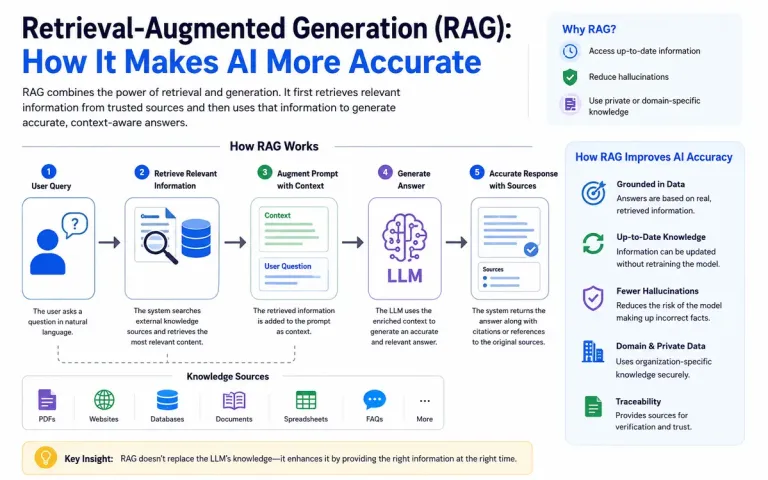
User Query → Retrieve Relevant Information → Add Information to Prompt → LLM Generates Answer
For example, imagine that a company's employee asks:
"What is our company's policy on working from home?"
A normal LLM may not know the company's internal policy.
A RAG system can:
Receive the employee's question.
Search the company's policy documents.
Retrieve the relevant section.
Provide that information to the LLM.
Generate an answer based on the retrieved document.
Therefore, the model does not have to rely solely on what it learned during training.
Why Do AI Models Need RAG?
Large language models are trained on enormous quantities of data. However, training a model does not mean that it has perfect access to all that information.
Several problems can occur.
1. Outdated Knowledge
Information changes continuously.
For example:
company policies change;
product prices change;
government regulations change;
software documentation changes;
market conditions change;
research findings are updated.
An LLM trained on older information may produce an outdated response.
RAG can connect the model to a knowledge base that is updated independently of the model.
2. Hallucinations
An AI hallucination occurs when a model produces information that appears convincing but is unsupported or incorrect.
For example, an AI might invent:
a research paper;
a statistic;
a legal provision;
a product specification;
a company policy;
a citation.
RAG can reduce this problem by providing relevant source material that the model can use when formulating its response.
However, it is important to understand that RAG does not eliminate hallucinations completely. If the retrieval system retrieves poor information, the model can still generate an incorrect answer.
3. Lack of Domain-Specific Knowledge
A general-purpose LLM may have broad knowledge but may not understand the detailed internal information of a particular organization.
Consider a university.
The university may have thousands of documents containing:
admission rules;
examination policies;
faculty regulations;
course structures;
academic calendars;
research guidelines;
scholarship rules.
Instead of retraining an LLM whenever these documents change, the institution can place the documents into a searchable knowledge base and use RAG.
4. Private or Proprietary Information
Organizations often have information that is not publicly available.
Examples include:
internal reports;
employee manuals;
customer records;
product documentation;
technical manuals;
business processes;
internal research.
A RAG system can be designed to retrieve information from authorized internal sources rather than expecting the general-purpose model to already know it.
How Does RAG Work?
A typical RAG system consists of several stages.
Step 1: Collect the Knowledge
The first step is to identify the information that the AI should be able to access.
Sources may include:
PDF documents;
Word files;
websites;
databases;
spreadsheets;
product manuals;
research papers;
FAQs;
company policies;
knowledge bases.
Suppose a company wants to build an AI customer-support assistant.
It might collect:
product manuals;
troubleshooting guides;
warranty policies;
frequently asked questions;
installation instructions.
These documents become the knowledge source for the RAG system.
Step 2: Document Processing
Raw documents are usually not placed directly into the retrieval system.
They first need to be processed.
The system may:
extract text;
remove unnecessary information;
identify document structure;
divide large documents into smaller sections;
preserve useful metadata.
This process is important because retrieval works better when information is organized into meaningful pieces.
Step 3: Chunking
Large documents are normally divided into smaller pieces called chunks.
For example, a 100-page employee handbook could be divided into sections such as:
Leave Policy
Attendance Policy
Remote Work Policy
Performance Evaluation
Workplace Conduct
Instead of searching the entire document every time, the retrieval system can search these smaller pieces.
Good chunking is important because chunks that are too large may contain unnecessary information, while chunks that are too small may lose important context.
Step 4: Creating Embeddings
RAG systems often use embeddings to represent text mathematically.
An embedding converts text into a numerical vector that captures aspects of its semantic meaning.
For example:
"How can I reset my password?"
and
"I forgot my login password. What should I do?"
use different words but have similar meanings.
Their embeddings should therefore be relatively close in vector space.
This enables semantic search.
Step 5: Storing Information in a Vector Database
The embeddings can be stored in a vector database.
Examples of technologies commonly used for vector search include:
Pinecone
Weaviate
Milvus
Qdrant
pgvector
Elasticsearch/OpenSearch with vector capabilities.
The database stores the vector representations along with the original text and often metadata such as:
document title;
author;
date;
department;
access permissions;
URL.
Step 6: User Asks a Question
The process begins when the user submits a question.
For example:
"What is the company's policy for parental leave?"
The question is converted into an embedding.
The system then searches the knowledge base for semantically similar information.
Step 7: Retrieval
The retrieval component identifies the most relevant pieces of information.
For example, it might retrieve:
Document: Employee Handbook
Section: Parental Leave Policy
Employees who meet the eligibility requirements are entitled to parental leave according to the company's current leave policy.
The system may retrieve several relevant chunks rather than just one.
Modern RAG systems can also use techniques such as:
semantic search;
keyword search;
hybrid search;
reranking;
metadata filtering.
Research surveys commonly describe RAG as involving multiple stages, including pre-retrieval, retrieval, post-retrieval, and generation.
Step 8: Context Is Added to the Prompt
The retrieved information is then supplied to the LLM as context.
Conceptually:
User Question + Retrieved Knowledge → LLM
The model is instructed to use the supplied information when generating the response.
Step 9: Generation
Finally, the LLM generates the answer.
Instead of responding entirely from its internal knowledge, it can use the retrieved information as evidence.
For example:
"According to the company's employee handbook, eligible employees can take parental leave under the organization's current leave policy."
If the system is designed properly, it may also provide the source document or citation.
RAG Architecture
A simplified RAG architecture can be represented as:
Knowledge Sources
↓
Document Processing
↓
Chunking
↓
Embedding Model
↓
Vector Database / Search Index
↓
User Query
↓
Query Embedding
↓
Retriever
↓
Relevant Context
↓
Large Language Model
↓
Generated Answer
The architecture can become significantly more sophisticated in production environments, with query rewriting, hybrid retrieval, reranking, filtering, evaluation, and feedback loops.
RAG vs Traditional LLM
There is an important difference between a traditional LLM and a RAG-based system.
| Feature | Traditional LLM | RAG-Based LLM |
|---|---|---|
| Knowledge source | Mainly model parameters | Model + external knowledge |
| Current information | Limited by knowledge access | Can retrieve updated information |
| Private company information | Not automatically available | Can connect to authorized sources |
| Domain-specific information | May be limited | Can retrieve specialized documents |
| Hallucination risk | Can be significant | Can be reduced with good retrieval |
| Knowledge updates | Usually require model updates or other mechanisms | Knowledge base can often be updated independently |
| Source attribution | Not inherent | Can be designed to provide sources |
| Implementation complexity | Lower | Higher |
The key advantage is that RAG allows an LLM to work with information that is external to its original training process. Research surveys identify outdated knowledge, hallucination, and domain-specific limitations among the major motivations for RAG.
How RAG Improves AI Accuracy
RAG can improve AI accuracy in several ways.
1. Grounding Responses in External Information
The most important advantage is grounding.
Instead of generating an answer based entirely on learned patterns, the model receives relevant information from a designated knowledge source.
This can make the answer more evidence-based.
2. Access to Updated Information
Suppose an organization updates its refund policy.
With a RAG system, the updated policy can replace or supplement the old document in the knowledge base.
The LLM itself may not need to be retrained.
This separation between the model and the knowledge base is one of RAG's major practical advantages.
3. Better Domain-Specific Answers
A general LLM may know what "inventory turnover" means.
But a company's internal question might be:
"What inventory turnover target does our organization use for Product Category A?"
That answer may exist only in the company's internal documents.
RAG can retrieve the relevant business information and allow the LLM to formulate the response.
4. Better Traceability
A RAG application can be designed to show:
document name;
page number;
source URL;
retrieved passage;
publication date.
This provides users with a way to verify the answer.
The original RAG research highlighted provenance and updating world knowledge as important challenges for language models.
An Example of RAG in Customer Support
Imagine an electronics company selling laptops.
A customer asks:
"My laptop battery is not charging. What should I do?"
The RAG system might search:
laptop troubleshooting manual;
battery FAQ;
warranty documentation;
technical support database.
It retrieves the relevant troubleshooting instructions.
The LLM then converts those technical instructions into a conversational answer:
"First, disconnect the charger and restart the laptop. Then check whether the charging indicator appears when the adapter is connected. If the problem continues, the battery or adapter may require technical inspection."
The important point is that the LLM is not necessarily inventing the troubleshooting procedure. It is generating a natural-language response based on retrieved company documentation.
RAG in Business
RAG has significant applications in business.
1. Customer Service
Companies can build AI assistants that retrieve information from:
product manuals;
FAQs;
support tickets;
warranty policies;
troubleshooting guides.
This can help customer-service teams provide faster and more consistent responses.
2. Human Resource Management
HR departments can use RAG to answer questions about:
leave policies;
employee benefits;
workplace rules;
recruitment procedures;
organizational policies.
An employee could ask:
"How many days of leave am I entitled to under the current policy?"
The system retrieves the appropriate HR document and generates the response.
3. Marketing
Marketing teams can use RAG to work with:
market research;
customer surveys;
product information;
competitor reports;
campaign performance data;
brand guidelines.
For example:
"What were the major customer complaints in the last quarter?"
A RAG system can retrieve information from customer-feedback databases and reports and summarize the findings.
4. Research and Academia
Researchers can use RAG to search and analyze:
research papers;
institutional reports;
datasets;
books;
technical documentation.
A properly designed system can retrieve relevant literature before generating a summary or comparison.
However, researchers should still verify original sources rather than treating an AI-generated answer as authoritative.
5. Legal and Compliance
Organizations can use RAG to search:
internal compliance documents;
regulations;
contracts;
policies;
regulatory guidance.
Because legal information is high-stakes and can change, retrieval quality, source authority, version control, and human review are especially important.
RAG and Search Engines: What Is the Difference?
RAG and traditional search are related but serve different purposes.
A search engine primarily helps users find information.
RAG retrieves information and then allows an LLM to generate an answer based on that information.
For example:
Traditional Search
User:
"What is our refund policy?"
System:
Here are five documents related to refunds.
RAG
User:
"What is our refund policy?"
System:
"According to the current refund policy, customers can request a refund within the specified eligibility period. Certain products and conditions may be excluded."
The second system transforms retrieved information into a conversational response.
RAG vs Fine-Tuning
RAG and fine-tuning are sometimes confused, but they solve different problems.
Fine-Tuning
Fine-tuning changes the model's behavior by training it further on specific examples.
It is useful when you want to modify:
style;
behavior;
task performance;
response patterns.
RAG
RAG provides the model with external information at inference time.
It is particularly useful when you need:
current information;
private information;
frequently changing information;
domain-specific documents;
source-based answers.
In many applications, RAG and fine-tuning can also be used together.
Types of RAG
RAG has evolved beyond a simple "retrieve and generate" architecture.
1. Naive RAG
The basic pipeline is:
Query → Retrieve → Generate
It is relatively simple and useful for basic applications.
2. Advanced RAG
Advanced systems introduce improvements such as:
query rewriting;
better chunking;
metadata filtering;
reranking;
hybrid retrieval;
contextual compression.
These techniques attempt to improve the quality of the information provided to the LLM.
3. Modular RAG
More sophisticated architectures treat different components as interchangeable modules.
For example:
Query Transformation → Retrieval → Reranking → Context Processing → Generation → Evaluation
Research surveys describe the evolution from simpler RAG approaches toward advanced and modular architectures.
Challenges and Limitations of RAG
RAG is powerful, but it is not a perfect solution.
1. Poor Retrieval Leads to Poor Answers
This is perhaps the most important limitation.
If the system retrieves irrelevant information, the LLM may produce an incorrect answer based on that information.
In other words:
Bad Retrieval → Bad Context → Potentially Bad Generation
Improving the LLM alone cannot solve a retrieval problem.
2. Incorrect or Outdated Documents
RAG can only be as reliable as its knowledge sources.
If the company's database contains outdated policies, the AI may retrieve outdated information.
Therefore, organizations need:
document governance;
version control;
metadata;
regular updates;
access controls.
3. Chunking Problems
If documents are divided incorrectly, important context may be lost.
For example, a paragraph may say:
"Employees are entitled to 20 days of annual leave."
A later paragraph might state:
"This provision applies only to employees with more than two years of service."
If these pieces are separated incorrectly, the AI could misunderstand the policy.
4. Retrieval Bias
A retrieval system may consistently favor certain documents or sources.
This can produce incomplete answers.
For example, if an AI retrieves only positive customer reviews, its summary may fail to represent negative customer experiences.
5. Security and Access Control
Enterprise RAG systems must ensure that users can retrieve only information they are authorized to access.
For example, an employee should not automatically be able to ask an internal AI assistant:
"Show me the confidential salary details of senior executives."
Access control must therefore be integrated into the retrieval layer.
6. Context Window Limitations
Retrieving too much information can overwhelm the model.
Therefore, the goal is not simply:
"Retrieve as much information as possible."
The goal is:
Retrieve the most relevant information.
This makes retrieval quality and context management extremely important.
How to Build an Effective RAG System
A successful RAG system requires more than connecting a vector database to an LLM.
Step 1: Define the Use Case
Determine:
What questions should the system answer?
Who will use it?
What sources should it access?
How accurate must it be?
Step 2: Prepare High-Quality Data
Clean and organize the documents.
Remove:
duplicate information;
obsolete documents;
irrelevant content;
corrupted text.
Step 3: Design Good Chunking
Create meaningful chunks that preserve context.
Chunk size should depend on the document type and application.
Step 4: Choose an Appropriate Retrieval Method
Possible approaches include:
keyword retrieval;
semantic retrieval;
vector search;
hybrid search.
Hybrid search can combine keyword matching with semantic similarity.
Step 5: Add Reranking
The initial retrieval stage may return several candidate passages.
A reranker can reorder those passages according to their relevance to the query.
Step 6: Control the Context
Only the most useful information should be provided to the LLM.
This can improve both efficiency and answer quality.
Step 7: Require Source-Based Responses
For knowledge-intensive applications, instructing the system to identify its supporting sources can improve transparency.
Step 8: Evaluate the Complete Pipeline
Evaluation should not focus only on the final answer.
Organizations should evaluate:
Retrieval Quality + Context Quality + Generation Quality
A system can fail even when the LLM itself is highly capable if the retrieval component retrieves the wrong information.
How RAG Should Be Evaluated
Important evaluation dimensions include:
Retrieval Accuracy
Did the system retrieve the relevant document or passage?
Context Relevance
Was the retrieved information actually relevant to the question?
Answer Faithfulness
Is the generated answer supported by the retrieved information?
Answer Correctness
Is the final answer factually correct?
Completeness
Did the answer include the important information needed to answer the question?
Latency
How quickly can the system retrieve information and generate an answer?
Cost
How much does each query cost in terms of:
retrieval;
embeddings;
database operations;
LLM inference?
These dimensions are important because RAG is a system, not simply a model.
The Future of RAG
RAG continues to evolve as researchers explore better methods for retrieval, reasoning, context management, and integration with external information.
Recent surveys identify challenges involving retrieval quality, scalability, domain adaptation, reasoning, and the effective use of external data.
Future RAG systems are likely to become increasingly capable of:
understanding complex questions;
searching multiple knowledge sources;
combining structured and unstructured data;
reasoning across multiple documents;
identifying conflicting information;
dynamically selecting retrieval strategies;
providing stronger source attribution;
integrating with enterprise databases and applications.
The broader direction is moving from simple retrieval toward systems that can retrieve, reason, verify, and act.
RAG and AI Agents
RAG is also becoming an important component of AI agents.
An AI agent may need to:
understand a user's objective;
retrieve relevant information;
reason about the information;
use external tools;
perform an action;
verify the result.
For example, an AI sales agent could retrieve:
customer history;
product specifications;
pricing information;
previous interactions;
company policies.
It could then use this information to recommend an appropriate product or prepare a customer response.
Thus, RAG can function as the knowledge-access layer of an AI agent.
A Simple Real-World Analogy
Imagine asking a student:
"What is the university's attendance policy?"
There are two possible situations.
Without RAG
The student answers from memory.
The answer may be:
correct;
incomplete;
outdated;
confused with another university's policy.
With RAG
The student is allowed to open the current university handbook before answering.
The student:
searches the handbook;
finds the attendance section;
reads the relevant rules;
answers the question;
shows the source if required.
This is essentially what RAG does for an AI system.
The LLM provides the language and reasoning capability; the retrieval system provides relevant external knowledge.
Key Advantages of RAG
The major advantages can be summarized as follows:
Access to external knowledge
Potentially more accurate answers
Reduced dependence on static model knowledge
Support for updated information
Access to private organizational knowledge
Better domain-specific responses
Potential source attribution
No need to retrain the entire model for every knowledge update
Useful for enterprise knowledge management
Can be combined with AI agents and other tools
Research has consistently identified RAG as a practical way of augmenting LLMs with external information, particularly for knowledge-intensive applications.
Key Limitations
RAG also has important limitations:
Retrieval can fail.
Poor documents produce poor answers.
Chunking can remove important context.
Retrieval can introduce bias.
Large amounts of context can increase cost and latency.
Security and access control can be difficult.
RAG does not completely eliminate hallucinations.
Complex questions may require multi-step retrieval and reasoning.
Knowledge bases need continuous maintenance.
Evaluation requires monitoring the entire pipeline.
Therefore, RAG should not be viewed as a magic solution for AI accuracy.
Conclusion
Retrieval-Augmented Generation represents an important shift in how AI systems use knowledge.
Traditional LLMs primarily depend on information encoded in their parameters. RAG adds an external knowledge layer that allows the system to retrieve relevant information before generating a response.
The basic principle is simple:
Retrieve relevant information → provide it to the model → generate a grounded response.
This architecture can help address several limitations of LLMs, including outdated knowledge, limited access to private information, domain-specific knowledge gaps, and hallucination risks. The original RAG work demonstrated that combining retrieval with generation could improve performance on knowledge-intensive tasks and produce more factual and specific language than a parametric-only baseline.
However, the effectiveness of RAG depends heavily on the quality of the underlying knowledge base, retrieval mechanism, document processing, context management, and evaluation process.
The most important lesson is therefore:
RAG does not make AI accurate simply by adding a database. It makes AI more reliable when high-quality information is retrieved, correctly interpreted, and appropriately used during generation.
As businesses increasingly deploy AI for customer service, research, marketing, education, knowledge management, and decision support, RAG is likely to remain an important foundation for building AI systems that can work with current, specialized, and organization-specific knowledge.
Related articles:-
How AI Agents Work: Architecture, Capabilities and Applications
AI Agents vs AI Chatbots: What Is the Difference?
AI Hallucinations: Why AI Can Generate Incorrect Information
Artificial Intelligence and Personal Data Privacy
Frequently Asked Questions
What does RAG stand for in AI?
RAG stands for Retrieval-Augmented Generation. It is an architecture that combines information retrieval with generative AI.
Does RAG eliminate AI hallucinations?
No. RAG can reduce the risk of hallucination by grounding responses in retrieved information, but it cannot guarantee that every answer will be correct.
Does RAG require fine-tuning?
Not necessarily. One of RAG's advantages is that an organization can connect an LLM to an external knowledge base without retraining the entire model whenever the knowledge changes.
What is a vector database in RAG?
A vector database stores numerical representations, called embeddings, that allow a system to find information based on semantic similarity.
Is RAG better than fine-tuning?
Neither is universally better. RAG is particularly useful for accessing external and changing knowledge, while fine-tuning is useful for modifying model behavior or improving performance on particular tasks. They can also be combined.
Can RAG use PDFs?
Yes. PDFs can be processed, divided into chunks, embedded, and stored in a retrieval system so that relevant passages can be retrieved when users ask questions.
Why is RAG important for businesses?
RAG allows businesses to build AI applications that can work with their own knowledge, including policies, product documentation, reports, FAQs, and other internal information.
What is the biggest weakness of RAG?
A major weakness is that retrieval quality determines the quality of the context supplied to the model. If the system retrieves irrelevant, incomplete, or outdated information, the generated answer may also be unreliable.
References
Lewis, P., et al. (2020). Retrieval-Augmented Generation for Knowledge-Intensive NLP Tasks. NeurIPS 2020.
Gao, Y., et al. (2024). Retrieval-Augmented Generation for Large Language Models: A Survey.
Huang, Y., & Huang, J. (2024). A Survey on Retrieval-Augmented Text Generation for Large Language Models.
Zhao, S., et al. (2024). Retrieval Augmented Generation (RAG) and Beyond: A Comprehensive Survey on How to Make your LLMs use External Data More Wisely. Microsoft Research.
Wu, S., et al. (2024). Retrieval-Augmented Generation for Natural Language Processing: A Survey.