Introduction
The rapid growth of Generative AI has changed the way people interact with technology. Instead of relying only on menus, commands, forms, and predefined options, users can now communicate with AI systems using ordinary language.
A person can ask a question, request a summary, write an email, explain a concept, analyze information, or generate computer code. Behind many of these capabilities are Large Language Models, commonly known as LLMs.
LLMs are a major type of deep-learning model trained on large amounts of language and other data. They can process and generate natural language and are used for tasks such as text generation, summarization, translation, question answering, and conversational AI. Many modern systems are based on transformer architectures, which use mechanisms such as self-attention to model relationships between tokens in context.
However, an LLM should not simply be understood as a machine that stores answers and retrieves them whenever a user asks a question. Its operation is based on learned statistical patterns that enable it to generate an output in response to the context it receives.
This article explains what Large Language Models are, how they work, how they are trained, where they are used, and why understanding their limitations is just as important as understanding their capabilities.
What Is a Large Language Model?
A Large Language Model is a type of AI model designed to process and generate language by learning patterns from very large amounts of data.
The term large generally refers to the scale of the model and its training process. Modern LLMs can contain very large numbers of parameters and are trained using substantial datasets and computing resources.
The term language model refers to the model's ability to work with language and predict or generate sequences of tokens.
A simple representation is:
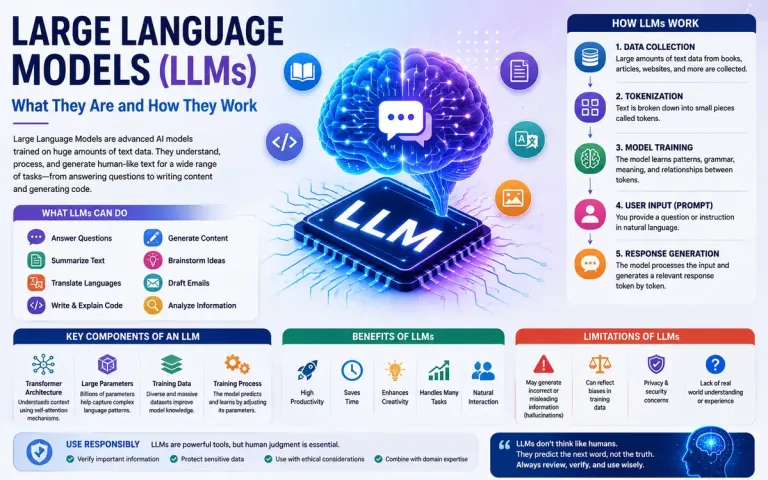
Large Amounts of Data → Training → Language Patterns → Trained LLM → User Input → Generated Response
An LLM can support tasks such as:
Answering questions
Writing and rewriting text
Summarizing documents
Translating languages
Generating computer code
Explaining concepts
Classifying information
Supporting conversational interfaces
This flexibility is one reason LLMs have become an important part of modern Generative AI.
Why Are LLMs Important?
Traditional software generally requires users to interact through predefined commands, buttons, forms, or instructions.
LLMs introduce a different model of interaction.
A user can express an objective in natural language.
For example:
Explain the concept of customer lifetime value in simple language.
The LLM processes the instruction and generates a response.
The user can then continue:
Give me a business example.
Or:
Explain it from the perspective of a small business.
This ability to work with natural language makes AI more accessible to a wider range of users.
Instead of learning a complex technical interface, people can increasingly communicate with technology through ordinary language.
How Do Large Language Models Work?
Although the internal processes of LLMs can be highly complex, their basic operation can be understood through a series of stages.
1. Language Is Converted into Tokens
Before an LLM can process language, the input must be represented in a form that the model can work with.
Text is divided into smaller units called tokens.
A token may represent:
A complete word
Part of a word
Punctuation
Another meaningful unit of text
For example, a sentence is converted into a sequence of tokens that can be processed mathematically.
The model then uses these tokens as the basis for further computation. (IBM)
2. Tokens Are Represented Mathematically
The tokens are converted into numerical representations, often referred to as embeddings.
These mathematical representations allow the model to process relationships between pieces of language.
For example, the model can learn that certain words or phrases frequently occur in related contexts.
However, the model is not simply matching individual keywords.
Modern transformer-based LLMs are designed to consider relationships between tokens within a larger context. (IBM)
3. The Transformer Processes Context
Most modern LLMs use a deep-learning architecture known as a transformer.
One of the important concepts associated with transformers is self-attention.
Self-attention helps the model evaluate the relationships between different tokens and determine which parts of the input are more relevant when processing the current context.
Consider the sentence:
The manager reviewed the report because it contained important sales information.
To understand what “it” refers to, the model must consider the surrounding context.
The relationships between words and tokens help the model generate a more contextually appropriate response.
This ability to model relationships across sequences of language is one of the reasons transformer architectures became so influential in modern language AI. (IBM)
How Are LLMs Trained?
Training an LLM is a complex and computationally intensive process.
A simplified representation is:
Training Data
↓
Tokens and Mathematical Representations
↓
Model Makes Predictions
↓
Error Is Evaluated
↓
Internal Parameters Are Adjusted
↓
Process Repeats Many Times
During training, the model repeatedly attempts to predict parts of the data and compares its output with the training objective.
The model's internal parameters are then adjusted to improve future predictions.
Over a very large number of training examples, the model learns statistical relationships associated with language.
This learning process can enable the model to capture patterns related to:
Grammar
Writing structures
Word relationships
Context
Styles of communication
Common patterns in information
The result is a trained model capable of processing new inputs and generating new outputs.
What Happens When You Ask an LLM a Question?
After training, the model can be used to respond to new inputs. This stage is commonly called inference.
Suppose a user enters:
Explain the difference between revenue and profit.
The process can be simplified as:
User Prompt
↓
Tokenization
↓
Context Processing
↓
Prediction of the Next Token
↓
Prediction of the Next Token
↓
Response Generation
The model generates the response step by step, based on probabilities and the context available to it.
This is why an LLM does not necessarily have the complete answer stored internally in the form of a prewritten response.
Instead, it generates the output as it processes the input and predicts an appropriate sequence of tokens.
What Are Parameters?
Parameters are internal numerical values that influence how a machine-learning model processes information and makes predictions.
During training, these values are adjusted as the model learns patterns from data.
The large number of parameters in modern LLMs contributes to their ability to represent complex relationships within language.
However, a larger number of parameters does not automatically guarantee that a model will always be better for every task.
Performance can also depend on factors such as:
Training quality
Model architecture
Fine-tuning
Available context
Tool integration
The specific task being performed
Therefore, the word “large” should not be interpreted simply as meaning that a model with more parameters is always superior.
What Can Large Language Models Do?
One of the most important characteristics of LLMs is their versatility.
A single model can often support multiple tasks.
Text Generation
LLMs can generate:
Articles
Emails
Reports
Product descriptions
Social media content
Business documents
The quality of the output depends on the model, prompt, context, and task.
Summarization
An LLM can process a large amount of text and generate a shorter summary.
This can be useful for:
Reports
Research material
Meeting notes
Business documents
Long articles
However, important summaries should still be reviewed to ensure that essential information has not been omitted or incorrectly represented.
Translation
Language models can support translation between languages.
They can also help users:
Rewrite text
Simplify complex language
Change tone
Adapt content for different audiences
Question Answering
LLMs can respond to questions expressed in natural language.
For example:
What is the difference between market segmentation and targeting?
The system can generate an explanation based on its learned patterns and the context available to it.
Code Assistance
LLMs can also support software development by helping users:
Generate code
Explain code
Identify possible errors
Create documentation
Suggest improvements
However, AI-generated code should be tested and reviewed before it is used in production systems.
LLMs and Chatbots: Are They the Same?
An LLM and a chatbot are related but not identical.
An LLM is the underlying language model.
A chatbot is an application or interface through which a user interacts with an AI system.
A chatbot may use an LLM to understand user input and generate responses.
However, it can also include other components such as:
User interface
Conversation history
Knowledge databases
Search systems
External tools
APIs
Security controls
Therefore, an LLM can be considered one of the important technologies that may power a modern AI chatbot.
This distinction is important because the same underlying LLM can potentially be used in different applications.
LLMs and Generative AI
Large Language Models are an important part of the Generative AI ecosystem.
The relationship can be represented as:
Artificial Intelligence
↓
Machine Learning
↓
Deep Learning
↓
Generative AI
↓
Large Language Models
LLMs are particularly associated with generating and processing language.
Other Generative AI models may specialize in areas such as:
Images
Audio
Video
Code
Multimodal content
Some modern AI systems are also multimodal, meaning they can process or generate more than one type of information, such as combinations of text, images, audio, or video.
The Importance of Prompts
The instruction provided to an LLM can significantly influence the output.
Consider the difference between:
Explain digital marketing.
And:
Explain digital marketing for a small-business owner with no marketing background. Use simple language and provide three practical examples.
The second prompt provides more context about:
The audience
The required level of explanation
The desired structure
This generally makes it easier for the model to produce a response aligned with the user's objective.
However, better prompting does not guarantee factual accuracy.
Prompting can improve relevance and clarity, but important information should still be verified.
Why Can LLMs Produce Incorrect Information?
One of the most important limitations of LLMs is that they can generate information that is inaccurate, misleading, or fabricated while appearing confident and fluent.
This is often called an AI hallucination, although NIST uses the more technical term confabulation in its Generative AI risk profile.
Because generative models produce outputs by predicting plausible sequences based on learned statistical patterns, fluent output is not the same as verified factual accuracy.
For example, an LLM may:
Provide an incorrect fact
Invent a reference
Misrepresent a source
Produce an inaccurate explanation
Generate a plausible but false statement
This means users should be particularly careful when working with:
Academic research
Financial information
Legal matters
Medical information
Business decisions
Technical documentation
The ability to produce convincing language should never be confused with a guarantee of truth.
Other Limitations of LLMs
LLMs also face several additional challenges.
Bias
Models can reflect patterns and biases present in their training data.
This can influence the outputs they generate.
Privacy and Confidentiality
Users should consider carefully before entering sensitive, confidential, or proprietary information into an AI system.
Organizations should establish appropriate policies governing the use of AI tools and organizational data.
Lack of Real-World Understanding
An LLM can generate language that appears to demonstrate understanding, but users should be cautious about assuming that the model experiences knowledge or understanding in the same way as a human being.
The system operates through computational processes and learned statistical relationships.
Computing Requirements
Developing and operating large models can require substantial computing infrastructure, energy, and financial resources.
How Can LLMs Become More Useful?
A general-purpose LLM can be enhanced by connecting it with additional information and tools.
For example, an LLM may be combined with:
Organizational databases
Search systems
APIs
Documents
External software
Retrieval systems
One important approach is Retrieval-Augmented Generation (RAG).
In a simplified form, RAG retrieves relevant information from an external knowledge source and provides that information to the model as part of the context used to generate a response.
This can help connect an LLM with more specific or current information without retraining the entire model.
This illustrates an important point:
An LLM alone is not necessarily the complete AI application.
More capable systems may combine language models with data sources, tools, retrieval mechanisms, and human oversight.
How LLMs Are Changing Business and Work
LLMs are increasingly being integrated into business processes because they can help employees interact with information using natural language.
Potential applications include:
Customer support
Knowledge management
Document drafting
Research assistance
Software development
Internal communication
Data interpretation
Workflow support
For example, an organization may combine an LLM with its internal knowledge base to help employees locate and understand relevant information.
However, the value of an LLM depends on how effectively it is integrated into the specific business process.
Simply adding a chatbot does not automatically create business value.
Organizations should consider:
The problem being solved
Data quality
Privacy and security
Accuracy requirements
Human oversight
Cost
Integration with existing systems
NIST's AI Risk Management Framework and its Generative AI profile emphasize the importance of managing risks throughout the design, development, use, and evaluation of AI systems.
The Future of Large Language Models
LLMs are likely to become increasingly integrated with other technologies.
Important directions include:
Multimodal AI
Models capable of working with combinations of:
Text
Images
Audio
Video
Code
AI Agents
LLMs can be combined with tools, APIs, memory, and decision logic to create systems capable of performing more complex tasks.
More Specialized Models
Smaller or domain-specific models may be developed for particular industries or organizational needs.
Better Integration with Data
Techniques such as RAG can connect models with external and changing information sources.
Improved AI Governance
As AI becomes more widely used, issues involving accuracy, bias, privacy, security, transparency, and accountability will become increasingly important.
The future of LLMs is therefore not only about developing larger models. It is also about developing systems that are more useful, reliable, efficient, secure, and appropriate for specific real-world applications.
Conclusion
Large Language Models represent one of the most important developments in modern Artificial Intelligence.
They enable computers to process and generate language at a scale that has made natural-language interaction with technology increasingly practical.
The basic process can be understood as:
Data → Training → Learned Patterns → LLM → User Prompt → Token Prediction → Generated Response
LLMs can support writing, summarization, translation, question answering, code assistance, and many other applications.
However, they are not perfect sources of truth. They can produce inaccurate or fabricated information, reflect biases, and create privacy or governance concerns.
The most effective approach is therefore to understand both their capabilities and limitations.
When combined with appropriate data, tools, verification, governance, and human judgment, LLMs can become a powerful component of modern AI systems.
Related articles:-
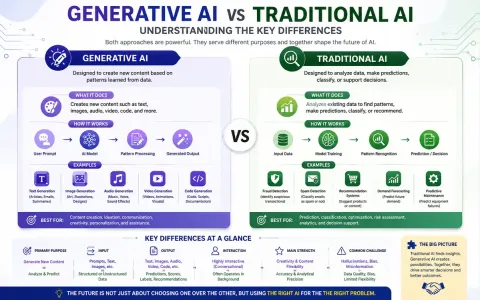
Generative AI vs Traditional AI
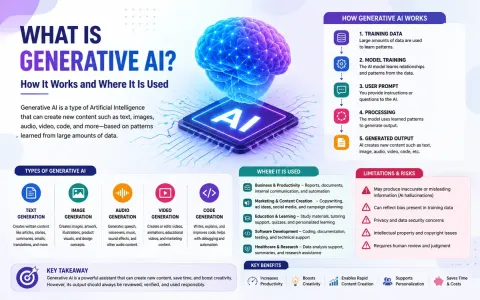
What Is Generative AI? How It Works
Machine Learning vs Artificial Intelligence
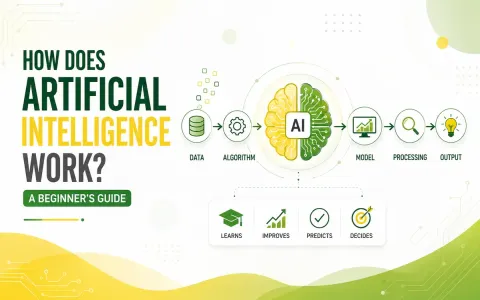
How Does Artificial Intelligence Work? A Beginner's Guide
Artificial Intelligence: A Complete Guide to A
Top 5 AI Tools Every Small Business Should Use
How Generative AI is Transforming Digital Marketing Strategies
Frequently Asked Questions
What is an LLM?
An LLM, or Large Language Model, is a deep-learning model trained on large amounts of language and other data to process and generate natural-language content.
How does an LLM generate text?
An LLM processes the input as tokens, uses the context and learned patterns within the model, and generates output by predicting a sequence of likely tokens.
Is an LLM the same as a chatbot?
No. An LLM is the underlying language model, while a chatbot is an application or interface that may use an LLM along with other components.
Can LLMs understand language like humans?
LLMs can process complex patterns and relationships in language, but their computational operation should not automatically be equated with human understanding or consciousness.
Why do LLMs sometimes provide incorrect answers?
LLMs generate responses based on learned statistical patterns and available context. As a result, they can produce plausible but inaccurate or fabricated information, sometimes called hallucinations or confabulations.
What is RAG?
Retrieval-Augmented Generation is an approach that retrieves relevant information from an external knowledge source and provides it as context to an LLM when generating a response.