Introduction
Artificial Intelligence has traditionally been used to analyze information, identify patterns, make predictions, and support decision-making. For example, an AI system might detect fraudulent transactions, recommend products, classify images, or predict future demand.
Generative AI represents an important development because it extends AI beyond analyzing existing information. Generative AI can create new content, including text, images, audio, video, computer code, and other forms of digital output.
Today, Generative AI is being used by individuals, businesses, educators, researchers, developers, marketers, and other professionals. A user can provide a simple instruction, question, or prompt, and an AI system can generate a response within seconds.
However, Generative AI is more than a collection of chatbots or image-generation tools. It is based on advanced machine-learning and deep-learning models capable of learning patterns from large amounts of data and using those patterns to generate new outputs.
This article explains what Generative AI is, how it works, where it is used, and what opportunities and limitations users should understand.
What Is Generative AI?
Generative AI is a type of Artificial Intelligence capable of creating new content based on patterns learned from data.
The generated output may include:
Text
Images
Audio
Video
Computer code
Designs
Summaries
Simulated or synthetic data
For example, a user may ask a Generative AI system to:
Write a blog outline
Summarize a document
Generate an image from a description
Create computer code
Translate text
Produce marketing ideas
Draft a business proposal
The system processes the input and generates an output based on patterns it learned during training.
An important distinction is that Generative AI does not simply retrieve a prewritten answer from a database for every request. Instead, it uses a trained model to generate an output in response to the input it receives.
How Does Generative AI Work?
Although the underlying technology can be highly complex, the basic process can be understood through a simplified sequence:
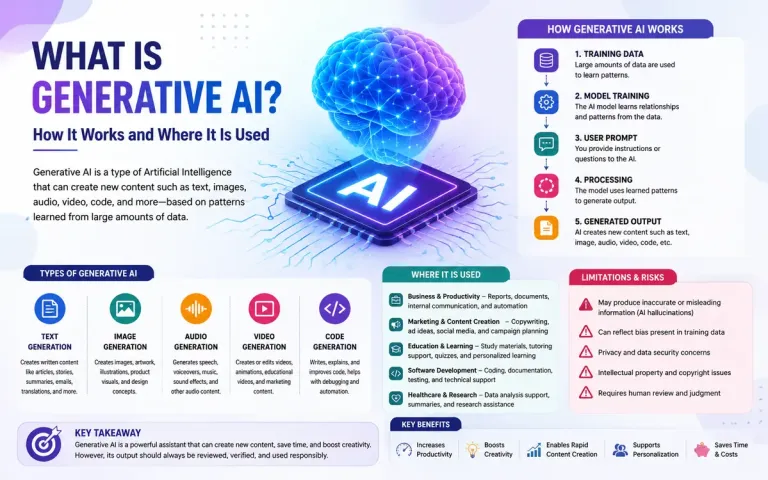
Training Data → Model Training → Learned Patterns → User Prompt → Processing → Generated Output
1. Training Data
Generative AI models are trained using large amounts of data.
Depending on the purpose of the system, this may include:
Books and documents
Articles and other text
Images
Audio
Video
Computer code
Other relevant forms of data
During training, the system identifies patterns and relationships within the available data.
For a language model, this may involve learning relationships between words, phrases, sentences, and broader linguistic structures.
For an image-generation model, the system learns patterns associated with visual elements, styles, objects, and relationships.
2. Model Training
During training, the AI model repeatedly processes data and adjusts internal parameters to improve its ability to perform its intended task.
The model does not develop knowledge in exactly the same way as a human being learns through experience.
Instead, it uses mathematical and statistical processes to identify patterns and relationships within the data.
Modern Generative AI often relies on deep-learning models with large numbers of parameters. Training such systems can require substantial computing resources.
3. User Prompt
After training, users interact with a Generative AI system by providing an input.
This input is often called a prompt.
A prompt may be:
A question
An instruction
A description
A piece of text
An image
A combination of different types of information
For example:
Write a simple explanation of renewable energy for school students.
The AI system processes the prompt and uses its learned patterns to generate a relevant response.
The quality and clarity of the prompt can influence the usefulness of the output.
4. Generating the Output
The model processes the input and generates an output based on patterns learned during training.
For text generation, a language model generates a sequence of words or tokens based on the context provided.
For image generation, the system produces visual content based on the user's description and the patterns represented within the model.
The simplified process is:
Prompt → AI Model → Pattern Processing → Generated Output
The output may then be reviewed, edited, refined, or regenerated by the user.
Types of Generative AI
Generative AI can create different types of content.
Text Generation
Text-based Generative AI can assist with:
Writing
Summarization
Translation
Question answering
Brainstorming
Content development
Report drafting
Large Language Models, or LLMs, are an important technology behind many text-generation systems.
Image Generation
Image-generation systems can create visual content from written descriptions.
Possible applications include:
Illustrations
Marketing visuals
Concept designs
Educational graphics
Product concepts
Users provide a description, and the system generates an image based on the instruction.
Audio Generation
Generative AI can also create or transform audio.
Applications may include:
Synthetic speech
Voice generation
Music generation
Audio editing
Sound creation
Video Generation
AI is increasingly being used to generate and edit video content.
Potential applications include:
Educational videos
Marketing content
Visual demonstrations
Animation
Video editing
The capabilities of AI-generated video continue to develop rapidly.
Code Generation
Generative AI can assist software developers by generating, explaining, reviewing, or modifying computer code.
It can help with tasks such as:
Writing code
Explaining existing code
Identifying possible errors
Generating documentation
Creating simple prototypes
However, AI-generated code should be reviewed and tested rather than being accepted automatically.
Where Is Generative AI Used?
Generative AI is being applied across many fields.
Business
Businesses can use Generative AI to support:
Document creation
Communication
Research assistance
Customer support
Content development
Data analysis
Workflow assistance
The objective is often to improve productivity and assist employees rather than simply automate every activity.
Marketing
Generative AI can support marketing activities such as:
Content ideation
Drafting social media content
Creating advertising concepts
Developing campaign ideas
Producing initial content drafts
Personalizing communication
However, human judgment remains important to ensure that content is accurate, appropriate, and aligned with the organization's brand.
Education
In education, Generative AI can assist with:
Explaining concepts
Creating practice questions
Developing learning materials
Providing examples
Supporting personalized learning
At the same time, educators and institutions must consider issues related to academic integrity, accuracy, overreliance, and responsible use.
Software Development
Developers can use Generative AI to assist with coding, debugging, documentation, and technical explanations.
It can increase productivity, but generated code may contain errors, security problems, or unsuitable solutions.
Human review remains essential.
Healthcare and Research
Generative AI may support areas such as scientific research, documentation, communication, and the analysis or generation of relevant information.
In high-stakes areas such as healthcare, AI-generated outputs should not be treated as a replacement for qualified professional judgment.
Benefits of Generative AI
Generative AI offers several potential advantages.
Increased Productivity
AI can help users produce initial drafts, summaries, ideas, and other outputs more quickly.
This can reduce the time required for repetitive or time-consuming tasks.
Creativity and Ideation
Generative AI can act as a brainstorming assistant by suggesting alternative ideas, structures, approaches, or creative concepts.
Accessibility
AI tools can make certain forms of content creation more accessible to people who may not have specialized technical or creative skills.
Personalization
AI systems can potentially adapt content and communication to different users, audiences, or contexts.
Rapid Content Creation
Text, images, code, and other forms of content can be generated quickly, allowing users to develop and refine ideas more efficiently.
Limitations and Risks of Generative AI
Despite its capabilities, Generative AI has important limitations.
AI Hallucinations
Generative AI can sometimes produce information that appears convincing but is incorrect, misleading, or entirely fabricated.
This problem is often described as an AI hallucination.
Users should therefore verify important information, particularly when dealing with:
Academic research
Legal matters
Financial information
Medical information
Business decisions
Fluent writing should not automatically be mistaken for factual accuracy.
Bias
AI models can reflect patterns and biases present in their training data.
This may influence the content or recommendations they produce.
Responsible AI development requires attention to fairness, bias, and appropriate evaluation.
Privacy and Confidentiality
Users should be cautious about entering sensitive or confidential information into AI systems.
Organizations should establish clear policies regarding the use of proprietary, personal, financial, or confidential data.
Intellectual Property Concerns
The use of Generative AI raises questions relating to copyright, ownership, training data, and the use of AI-generated content.
These issues can depend on the applicable laws, policies, and specific circumstances.
Users should understand the rules that apply to the tools and content they use.
Lack of Human Judgment
Generative AI can assist with producing content, but it does not automatically possess human values, professional judgment, or an understanding of every real-world context.
Human oversight remains essential, especially when the consequences of an error are significant.
Generative AI and Human Creativity
One common concern is whether Generative AI will replace human creativity.
A more useful perspective may be to view AI as a tool that can support and extend human capabilities.
AI can quickly generate alternatives, ideas, drafts, and variations. However, humans remain responsible for defining objectives, evaluating quality, understanding context, exercising judgment, and making final decisions.
For example, a writer can use Generative AI to brainstorm article ideas, but the writer still determines:
The purpose of the article
The target audience
The arguments and perspective
The accuracy of the information
The final editorial quality
The most effective approach is often human creativity combined with appropriate AI assistance.
How to Use Generative AI Effectively
To use Generative AI responsibly and productively:
Provide Clear Instructions
Explain what you want the AI to do and provide relevant context.
Review the Output
Do not assume that generated content is automatically accurate.
Verify Important Information
Check facts, statistics, quotations, and other significant claims.
Protect Sensitive Data
Avoid sharing confidential or personal information unless you understand the relevant privacy and security policies.
Use AI as an Assistant
Treat AI as a tool for support, ideation, analysis, and productivity rather than an unquestioned authority.
The Future of Generative AI
Generative AI is likely to become increasingly integrated into software, business processes, education, creative work, and everyday digital tools.
Future developments may include:
More capable multimodal AI
Improved personalization
AI agents capable of completing more complex tasks
Better integration with business software
Advanced AI-assisted creativity
More sophisticated human-AI collaboration
At the same time, responsible development will become increasingly important.
Issues involving accuracy, misinformation, privacy, copyright, security, bias, and transparency will continue to shape how Generative AI is developed and used.
The future of Generative AI will therefore depend not only on technological progress but also on how effectively individuals, organizations, and governments manage its opportunities and risks.
Conclusion
Generative AI is an important development within Artificial Intelligence because it enables machines to create new forms of content rather than simply analyzing or classifying existing information.
Using advanced machine-learning and deep-learning models, Generative AI can produce text, images, audio, video, code, and other forms of digital output.
Its potential applications extend across business, marketing, education, software development, research, and creative industries.
However, Generative AI is not perfect. It can produce inaccurate information, reflect bias, create privacy concerns, and generate outputs that require careful human review.
The key to using Generative AI effectively is to understand both its capabilities and limitations.
When used responsibly, it can become a powerful tool for productivity, creativity, learning, and innovation.
The next article in this AI series will explore an important distinction:
Generative AI vs Traditional AI: Understanding the Key Differences
Related articles:-
Machine Learning vs Artificial Intelligence
How Does Artificial Intelligence Work
Artificial Intelligence: A Complete Guide https://bizinfotech.in/post/artificial-intelligence-complete-guide
Frequently Asked Questions
What is Generative AI?
Generative AI is a type of Artificial Intelligence capable of creating new content, such as text, images, audio, video, or code, based on patterns learned from data.
How does Generative AI work?
Generative AI models are trained on data to identify patterns and relationships. When a user provides a prompt or input, the trained model processes that information and generates a relevant output.
What can Generative AI create?
Generative AI can create or transform text, images, audio, video, computer code, designs, summaries, and other forms of digital content.
Is Generative AI the same as Artificial Intelligence?
No. Artificial Intelligence is the broader field. Generative AI is a specialized area within AI focused on generating new content.
Can Generative AI make mistakes?
Yes. Generative AI can produce inaccurate, misleading, biased, or fabricated information. Important outputs should be reviewed and verified.
What is the difference between Generative AI and traditional AI?
Traditional AI is often used to analyze, classify, predict, or make recommendations based on data. Generative AI focuses on creating new content based on patterns learned during training.