Introduction
Artificial intelligence (AI) is rapidly transforming the cybersecurity landscape. Organizations today generate enormous volumes of data through networks, cloud platforms, applications, mobile devices, and connected systems. Identifying a genuine cyber threat within this vast amount of information is increasingly difficult for human security teams alone.
AI provides new capabilities for analyzing data, recognizing patterns, detecting anomalies, and automating security operations. It can help organizations identify suspicious activities in real time and respond to potential threats more quickly.
However, AI has also created new cybersecurity challenges. Cybercriminals can use AI to automate attacks, generate convincing phishing messages, create synthetic voices and images, and improve social engineering campaigns. AI systems themselves can also become targets of cyberattacks.
As a result, AI is changing cybersecurity in two important ways:
AI is becoming a powerful tool for cyber defense.
AI is also creating new opportunities and attack surfaces for cybercriminals.
This dual role makes the relationship between AI and cybersecurity one of the most important technology issues of the digital age.
Recent work by the U.S. National Institute of Standards and Technology (NIST) reflects this dual perspective by focusing on three related areas: securing AI systems, conducting AI-enabled cyber defense, and thwarting AI-enabled cyberattacks.
What Is AI in Cybersecurity?
AI in cybersecurity refers to the use of artificial intelligence technologies to identify, analyze, predict, and respond to cyber threats.
Traditional cybersecurity systems often depend on predefined rules and known threat signatures. For example, a security system may block a particular malicious file because its characteristics are already known.
AI can add another layer of intelligence. Instead of relying only on predefined rules, AI systems can analyze large amounts of data and identify unusual patterns or behavior that may indicate a potential threat.
AI technologies used in cybersecurity may include:
Machine learning
Deep learning
Natural language processing
Behavioral analytics
Generative AI
Automated decision systems
For example, if an employee normally logs in from India during office hours but suddenly attempts to access sensitive company data from an unusual location at 3:00 a.m., an AI-based security system may identify this behavior as suspicious.
Therefore, AI can help cybersecurity move from a purely reactive approach toward a more proactive and adaptive approach.
How Artificial Intelligence Is Transforming Cybersecurity
1. AI Improves Threat Detection
One of the most important applications of AI in cybersecurity is threat detection.
Modern organizations generate massive quantities of security data, including:
Network traffic
Login records
System logs
Application activity
Email communications
Cloud events
User behavior
Human security analysts cannot manually examine every event.
AI systems can process large volumes of data and identify patterns that may indicate suspicious activity.
For example, AI may detect:
An unusual number of failed login attempts
Unexpected access to sensitive files
Abnormal network traffic
A device communicating with suspicious servers
Unusual user behavior
This capability is particularly useful because many cyberattacks do not initially appear as obvious threats. Instead, they may involve small and unusual changes in behavior.
AI-based anomaly detection can help security teams identify these changes before they develop into major incidents.
Example
Suppose an employee normally downloads five files per day. Suddenly, the employee's account begins downloading thousands of confidential files.
A traditional system may detect the activity only if a specific rule has been created.
An AI system analyzing normal behavior may recognize that this activity significantly differs from the employee's usual pattern and flag it for investigation.
2. AI Helps Detect Unknown Threats
Traditional cybersecurity tools are often highly effective against known threats. However, cybercriminals continuously develop new attack techniques.
An attack that has never been seen before may not match an existing threat signature.
AI can help address this challenge through:
Behavioral analysis
Anomaly detection
Pattern recognition
Predictive analysis
Instead of asking only:
"Does this activity match a known malicious signature?"
AI can also ask:
"Is this behavior unusual or potentially dangerous?"
This approach can improve the ability to detect previously unknown threats.
However, AI detection is not perfect. Unusual behavior is not always malicious. Therefore, organizations still need human analysts to investigate alerts and make important security decisions.
3. AI Automates Security Operations
Cybersecurity teams often face an overwhelming number of security alerts.
Some alerts represent genuine threats, while others may be harmless or low-risk events. Security professionals can spend significant amounts of time investigating and prioritizing these alerts.
AI can help automate repetitive security tasks such as:
Alert classification
Threat prioritization
Log analysis
Malware analysis
Suspicious email detection
Incident correlation
Automated response actions
This can reduce the workload of security teams and allow human experts to focus on more complex investigations.
For example, when a suspicious file is detected, an automated system may:
Identify the file.
Analyze its characteristics.
Compare its behavior with known threats.
Isolate the affected device.
Alert the security team.
This combination of AI and automation can significantly improve the speed of incident response.
4. AI Strengthens Endpoint Security
Organizations use a wide variety of endpoints, including:
Desktop computers
Laptops
Mobile devices
Servers
Internet of Things (IoT) devices
Each endpoint can potentially become an entry point for cybercriminals.
AI-powered endpoint security systems can monitor device behavior and identify suspicious activities.
For example, an AI system may detect:
Unauthorized software execution
Unusual file encryption activity
Suspicious processes
Abnormal communication with external servers
Attempts to disable security software
This can be particularly useful in detecting ransomware and other advanced threats.
Instead of waiting until a threat has fully executed, an AI system may identify suspicious behavior at an earlier stage and trigger a response.
5. AI Helps Detect Phishing and Email Threats
Phishing remains one of the most common methods used by cybercriminals.
Attackers may send fraudulent emails designed to:
Steal passwords
Obtain banking information
Deliver malware
Impersonate executives
Manipulate employees into transferring money
AI can help analyze multiple characteristics of an email, including:
Language patterns
Sender behavior
Suspicious links
Attachment characteristics
Writing style
Context and intent
Machine learning systems can identify patterns associated with malicious messages.
However, AI has also changed phishing attacks themselves. Attackers can now use generative AI to produce more convincing and grammatically accurate messages and to scale social-engineering campaigns. ENISA's 2025 threat landscape identified AI as an important trend, noting its use to enhance phishing and automate social engineering.
This creates an ongoing competition between AI-powered attackers and AI-powered defenders.
6. AI Improves Fraud Detection
AI is increasingly used to detect fraudulent activity in:
Banking
E-commerce
Digital payments
Insurance
Financial services
AI systems can analyze transaction patterns and identify activities that differ significantly from normal behavior.
For example, a system may identify:
An unusually large transaction
Multiple transactions within a short period
Transactions from unusual locations
Sudden changes in customer behavior
Repeated failed payment attempts
AI can assign a risk score to a transaction and determine whether it should be:
Approved
Blocked
Investigated
Subjected to additional verification
However, organizations must carefully manage false positives. A legitimate customer should not automatically be treated as fraudulent simply because their behavior appears unusual.
7. AI Supports Faster Incident Response
When a cyberattack occurs, speed is critical.
The longer an attacker remains inside a system, the greater the potential damage.
AI can help security teams:
Identify the incident
Analyze affected systems
Determine the severity
Correlate related security events
Recommend response actions
Automate certain defensive actions
For example, if malware is detected on a computer, an automated response system may immediately isolate the device from the network.
This can prevent the threat from spreading while human security professionals investigate the incident.
The objective is not necessarily to eliminate human involvement. Instead, AI can help humans make faster and better-informed decisions.
8. AI Helps Security Teams Analyze Large Volumes of Data
A modern organization may generate millions of security events every day.
These may include:
Firewall logs
Server logs
Authentication records
Cloud activity
Network traffic
Application events
Analyzing this information manually would be extremely difficult.
AI can help correlate information from multiple sources.
For example, a single failed login attempt may not be important. However, AI may identify a larger pattern:
Multiple failed login attempts
Successful login from an unusual location
Access to sensitive information
Large data transfer
Individually, these events may appear unrelated.
AI can help connect them and identify a potential attack pattern.
The Other Side: How Cybercriminals Are Using AI
AI is not available only to cybersecurity professionals.
Cybercriminals can also use AI to improve the scale, speed, and sophistication of malicious activities.
This is one of the most significant challenges created by AI.
1. AI-Generated Phishing Attacks
In the past, many phishing emails contained obvious spelling and grammatical mistakes.
Generative AI can help attackers create more professional and personalized messages.
An attacker may generate messages tailored to:
Employees
Customers
Executives
Students
Government officials
AI can also help attackers adapt messages for different languages and audiences.
This can make phishing campaigns more convincing and more difficult to identify.
2. AI and Social Engineering
Social engineering involves manipulating people rather than directly attacking technology.
AI can potentially make these attacks more sophisticated.
Attackers may use AI to analyze publicly available information and generate highly personalized messages.
For example, an attacker may impersonate:
A company executive
A bank representative
A colleague
A customer
A government official
The purpose is often to create trust and convince the victim to perform an action.
AI can increase the scale and personalization of such campaigns, which is why human awareness remains an essential part of cybersecurity.
3. Deepfakes and Digital Impersonation
AI can generate realistic:
Images
Audio
Video
Synthetic voices
These technologies can potentially be misused for impersonation and fraud.
For example, a cybercriminal may attempt to imitate the voice of a senior executive and request an employee to transfer money.
Such attacks demonstrate an important cybersecurity principle:
Seeing or hearing something is no longer sufficient evidence that it is genuine.
Organizations may therefore need stronger verification procedures for sensitive activities.
For example:
Multi-factor authentication
Independent confirmation
Approval workflows
Secure communication channels
Verification of unusual financial requests
4. AI Can Help Automate Cyberattacks
Cybercriminals often attempt to automate repetitive activities.
AI may increase their ability to:
Analyze large amounts of information
Create convincing content
Identify potential targets
Improve social engineering
Scale malicious campaigns
This does not mean that AI automatically makes every cybercriminal highly sophisticated. Many attacks still depend on traditional vulnerabilities, poor passwords, unpatched software, and human error.
Nevertheless, AI can potentially reduce the effort required for some malicious activities and increase the scale of attacks.
NIST's Cyber AI Profile explicitly recognizes AI-enabled cyberattacks as one of the major areas organizations must address.
AI Systems Are Also New Cybersecurity Targets
The discussion about AI and cybersecurity is not only about using AI to defend against attacks.
AI systems themselves must also be secured.
An AI system may involve:
Training data
Machine learning models
APIs
Cloud infrastructure
Third-party components
User inputs
Software dependencies
Each component can introduce potential vulnerabilities.
Important AI security concerns include:
1. Data Poisoning
Data poisoning occurs when an attacker attempts to manipulate the data used to train or update an AI system.
If malicious or manipulated data enters the system, it may affect the model's behavior or reliability.
2. Prompt Injection
Generative AI systems may process instructions provided by users or information retrieved from external sources.
Prompt injection attempts to manipulate the system through carefully designed instructions or content.
For example, an attacker may attempt to cause an AI application to:
Ignore intended instructions
Reveal protected information
Perform unintended actions
Process malicious instructions from external content
This is particularly important when AI systems are connected to databases, applications, tools, or organizational workflows.
3. Model Theft
AI models can represent valuable intellectual property.
Attackers may attempt to steal models, extract sensitive information, or reproduce certain model capabilities.
Organizations therefore need to consider security controls for:
Model storage
APIs
Access permissions
Training environments
Deployment infrastructure
4. Adversarial Attacks
An adversarial attack involves manipulating an input in a way that may cause an AI system to make an incorrect decision.
For example, carefully modified input data may attempt to confuse an AI-based detection system.
This demonstrates an important fact:
AI systems are not automatically secure simply because they are intelligent.
They require cybersecurity throughout their lifecycle.
International cybersecurity guidance increasingly emphasizes secure development and a Secure by Design approach for AI systems. (CISA)
Benefits of AI in Cybersecurity
AI provides several important advantages.
1. Speed
AI can analyze data much faster than human analysts.
2. Scalability
AI systems can monitor large and complex digital environments.
3. Pattern Recognition
AI can identify relationships and anomalies that may be difficult to detect manually.
4. Automation
Routine security activities can be automated.
5. Continuous Monitoring
AI-powered systems can operate continuously.
6. Improved Prioritization
AI can help security teams focus on high-risk events.
7. Faster Incident Response
Automated actions can reduce the time required to contain threats.
Limitations and Risks of AI in Cybersecurity
Despite its advantages, AI is not a complete solution.
1. False Positives and False Negatives
An AI system may incorrectly classify legitimate activity as malicious.
This is known as a false positive.
It may also fail to identify an actual threat.
This is known as a false negative.
Both can create serious problems.
2. Poor-Quality Data
AI systems depend heavily on the quality of the data used for training and operation.
Poor, biased, incomplete, or manipulated data can affect performance.
The principle of "garbage in, garbage out" remains relevant.
3. Lack of Explainability
Some AI systems can make complex decisions that are difficult for humans to understand.
In cybersecurity, explainability can be important because security professionals may need to understand:
Why an event was classified as malicious
What evidence was used
How confident the system is
What action should be taken
4. Overdependence on Automation
Organizations should avoid assuming that AI can solve every cybersecurity problem.
Automated systems can make mistakes.
Important security decisions, particularly those involving critical infrastructure, sensitive data, or major business operations, may require human oversight.
5. AI Creates New Attack Surfaces
When organizations introduce AI systems, they may also introduce new risks involving:
Models
Training data
APIs
Prompts
Third-party AI providers
Plugins and integrations
Autonomous actions
Therefore, AI adoption should be accompanied by appropriate risk management and governance.
NIST's AI Risk Management Framework and its Generative AI Profile provide guidance for organizations seeking to identify and manage risks associated with AI systems. (NIST)
Human Intelligence and AI: A Collaborative Approach
The future of cybersecurity is unlikely to involve AI completely replacing cybersecurity professionals.
Instead, the most effective approach is likely to combine:
Artificial Intelligence + Human Intelligence + Strong Security Processes
AI is particularly useful for:
Processing large amounts of data
Identifying patterns
Automating repetitive tasks
Monitoring systems continuously
Humans remain essential for:
Strategic decision-making
Complex investigations
Understanding business context
Ethical judgment
Security governance
Responding to unexpected situations
The goal should therefore be human-AI collaboration, rather than complete automation.
How Organizations Should Prepare for AI-Powered Cybersecurity
Organizations adopting AI should consider the following practices.
1. Use AI as Part of a Larger Security Strategy
AI should support existing cybersecurity controls rather than replace them.
Organizations still need:
Strong passwords
Multi-factor authentication
Encryption
Regular software updates
Access controls
Backups
Security monitoring
Employee awareness
2. Secure AI Systems by Design
Security should be considered during the entire AI lifecycle.
This includes:
Design
Development
Training
Testing
Deployment
Monitoring
Updating or retirement
A Secure by Design approach can reduce vulnerabilities before the system is widely deployed. (CISA)
3. Maintain Human Oversight
Organizations should establish clear rules regarding:
What AI systems can access
What decisions AI can make
Which actions require human approval
How AI-generated recommendations are reviewed
The greater the potential impact of an AI decision, the greater the need for appropriate oversight.
4. Train Employees
Technology alone cannot solve cybersecurity problems.
Employees should understand emerging threats such as:
AI-generated phishing
Deepfake impersonation
Voice fraud
Social engineering
Suspicious AI-generated content
Awareness training should focus on verification rather than assuming that realistic-looking content is genuine.
5. Monitor AI Systems Continuously
AI systems can change over time because:
Threats evolve
Data changes
Attackers develop new techniques
System integrations change
Therefore, AI security requires continuous monitoring and improvement.
The Future of AI and Cybersecurity
AI is likely to become an increasingly important component of cybersecurity.
Future security systems may become more capable of:
Predicting potential attacks
Detecting abnormal behavior in real time
Automating incident response
Identifying sophisticated fraud
Analyzing global threat intelligence
Protecting complex cloud and IoT environments
At the same time, attackers will continue to adopt new AI capabilities.
This means cybersecurity will increasingly become an AI-versus-AI environment, although human expertise will remain central to both defense and governance.
The key challenge for organizations will not simply be adopting AI.
It will be adopting AI securely, responsibly, and strategically.
NIST's ongoing Cyber AI Profile work illustrates the direction of this field by treating AI as both a cybersecurity capability and a source of cybersecurity risk.
Conclusion
Artificial intelligence is fundamentally changing digital security.
AI enables organizations to analyze massive amounts of information, detect suspicious activity, automate repetitive tasks, identify emerging threats, and respond to incidents more quickly.
However, the same technology can also be used by cybercriminals to improve phishing, impersonation, fraud, and other malicious activities. In addition, AI systems themselves create new assets and attack surfaces that organizations must protect.
Therefore, AI should not be viewed as a magic solution to cybersecurity.
The future of digital security will depend on a balanced combination of:
Artificial intelligence
Human expertise
Strong cybersecurity practices
Secure system design
Continuous monitoring
Risk management and governance
As AI continues to evolve, cybersecurity must evolve with it. Organizations that understand both the opportunities and risks of AI will be better positioned to protect their systems, data, employees, and customers in an increasingly complex digital environment.
Ultimately, the future of cybersecurity is not simply about building smarter technology. It is about ensuring that technology is secure, trustworthy, responsibly governed, and supported by informed human decision-making.
Related articles:-
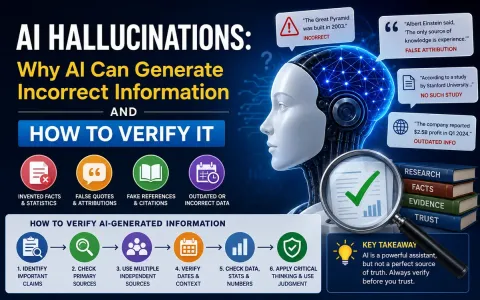
AI Hallucinations: Why AI Can Generate Incorrect Information and How to Verify It
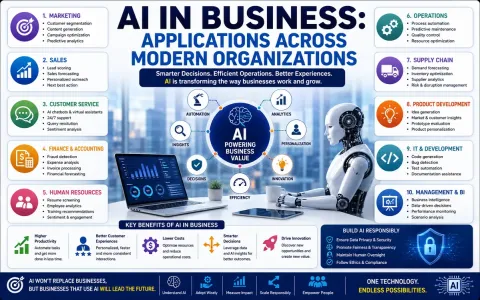
AI in Business: Applications Across Modern Organizations
Artificial Intelligence and Personal Data Privacy: Risks, Challenges, and Best Practices
Artificial Intelligence: A Complete Guide to AI, Its Types, Applications, and Impact
Why Every Small Business Needs an AI Strategy in 2026
References
National Institute of Standards and Technology (NIST). (2023). Artificial Intelligence Risk Management Framework (AI RMF 1.0). NIST AI 100-1. View publication
Autio, C., Schwartz, R., Dunietz, J., Jain, S., Stanley, M., Tabassi, E., Hall, P., & Roberts, P. (2024). Artificial Intelligence Risk Management Framework: Generative Artificial Intelligence Profile. NIST AI 600-1. National Institute of Standards and Technology. View publication
National Institute of Standards and Technology (NIST). (2025). Cybersecurity Framework Profile for Artificial Intelligence (Cyber AI Profile): NIST Community Profile. NIST Internal Report 8596, Initial Preliminary Draft. View Cyber AI Profile
National Institute of Standards and Technology (NIST). (2026). Workshop Summary Report for “Cyber AI Profile” Hybrid Workshop #2. NIST Internal Report 8607. View workshop report
Cybersecurity and Infrastructure Security Agency (CISA). (2023). Guidelines for Secure AI System Development. Developed in collaboration with the UK National Cyber Security Centre and international partners. View guidelines
European Union Agency for Cybersecurity (ENISA). (2025). ENISA Threat Landscape 2025. View report