In today's rapidly changing business environment, organizations are no longer competing solely on the basis of technology, cost, or quality. They are competing on their ability to understand people, solve complex problems, and create meaningful experiences. This is where Design Thinking has emerged as a powerful strategic approach.
What is Design Thinking?
Design Thinking is a human-centered, iterative process for solving complex problems by understanding users' needs, generating creative ideas, developing prototypes, testing solutions, and continuously improving them based on feedback.
Unlike traditional problem-solving methods that often begin with technology or available resources, Design Thinking starts with a simple but powerful question:
"What problem does the user actually face?"
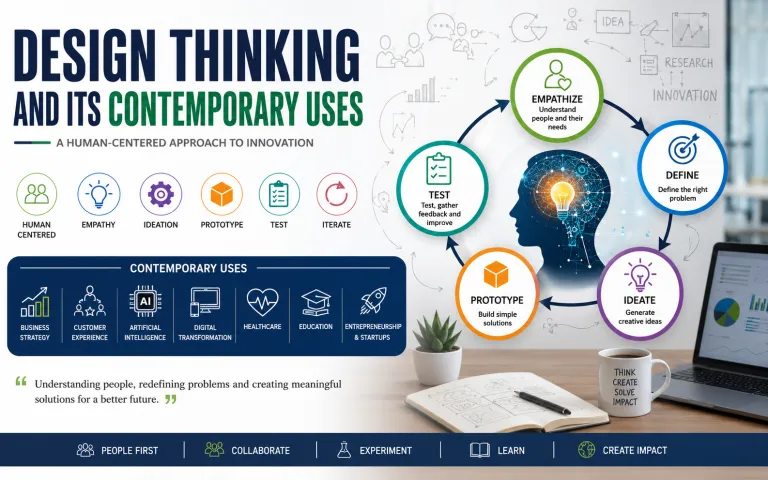
The process typically follows five stages:
- Empathize – Understand users and their needs.
- Define – Clearly identify the core problem.
- Ideate – Generate innovative solutions.
- Prototype – Develop a simple model of the solution.
- Test – Evaluate, learn, and refine.
Since the process is iterative, organizations continually improve solutions based on user feedback.
Is Design Thinking a New Concept?
Human beings have always innovated. From the invention of the wheel to the development of the airplane and modern artificial intelligence, every major innovation has emerged in response to a problem or need. As the well-known proverb says:
"Necessity is the mother of invention."
What makes Design Thinking different is not the act of innovation itself. Rather, it provides a structured and systematic methodology for innovation by placing human needs at the center of the problem-solving process.
Contemporary Uses of Design Thinking
Today, Design Thinking extends far beyond product design. It has become an essential strategic capability across industries.
Business Strategy
Organizations use Design Thinking to identify market opportunities, develop innovative business models, and create sustainable competitive advantages.
Marketing and Customer Experience
Companies design products, services, and customer journeys based on user insights rather than assumptions, resulting in stronger customer relationships and brand loyalty.
Artificial Intelligence
Design Thinking and AI complement each other. While Design Thinking identifies human needs and defines meaningful problems, AI provides intelligent, data-driven solutions through prediction, automation, and personalization. Together, they enable organizations to build technology that is both innovative and user-centered.
Digital Transformation
Businesses apply Design Thinking to redesign digital services, improve user interfaces, and create seamless customer experiences.
Healthcare
Hospitals and healthcare providers use Design Thinking to improve patient care, simplify clinical processes, and enhance healthcare delivery.
Education
Educational institutions redesign teaching methods, learning experiences, and digital platforms by focusing on students' needs.
Entrepreneurship
Startups use Design Thinking to validate ideas, understand customer expectations, develop prototypes, and reduce the risk of market failure.
Why Design Thinking Matters Today
Modern organizations operate in an environment characterized by rapid technological change, evolving customer expectations, and increasing competition. Design Thinking enables organizations to:
- Develop customer-centric solutions.
- Encourage creativity and innovation.
- Reduce uncertainty through experimentation.
- Improve decision-making.
- Foster collaboration across disciplines.
- Create sustainable business value.
Conclusion
Innovation is as old as humanity, but Design Thinking has transformed innovation into a systematic, human-centered management approach. By combining empathy, creativity, experimentation, and continuous learning, organizations can develop solutions that are not only technologically feasible but also desirable for users and viable for businesses.
As organizations increasingly adopt Artificial Intelligence, digital transformation, and customer-centric strategies, Design Thinking will continue to play a vital role in shaping the future of business and innovation.