Real-Life Case Study in Event Planning, Project Management, and Risk Management
Planning a large event requires more than arranging a venue, inviting speakers, and managing logistics. Successful event management also depends on identifying potential risks and preparing for unexpected situations.
This real-life case study demonstrates what can happen when an important risk—weather—is overlooked.
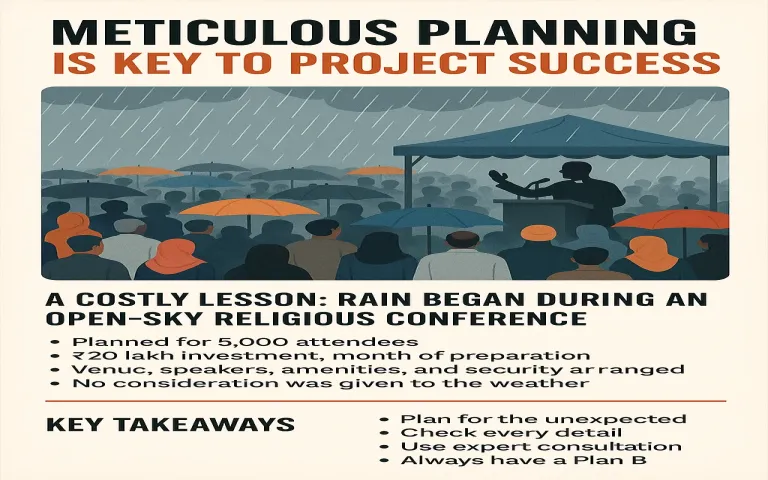
A grand religious conference was planned with high expectations and significant investment. Nearly 100 people were involved in organizing the event, and approximately ₹20 lakh was invested in preparations and arrangements.
The organizing team carefully planned many aspects of the event. However, one critical factor was overlooked: weather risk.
The result was a major operational failure and a significant financial loss.
The Event Plan: Everything Seemed Ready
The organizing team approached the event with considerable effort and preparation. Several important arrangements were completed well in advance.
1. Venue Selection
A large 50-acre open field was selected to accommodate a potentially large gathering. The venue provided sufficient space for attendees, parking, movement, and other event-related activities.
However, because the venue was completely open, it was highly exposed to weather conditions.
2. Religious Speakers
Several prominent religious speakers were contacted and invited to participate in the conference. Payments and other commitments were made in advance.
This created a significant financial commitment before the event even began.
3. Logistics and Crowd Management
The organizers made arrangements for:
- Parking facilities
- Access and entry paths
- Separate areas for women
- Crowd movement
- Food and refreshment facilities
- Drinking water
The team invested considerable time and resources to ensure that visitors would have a comfortable experience.
4. Security Arrangements
Security was also considered an important part of the event plan.
The local police were informed about the expected gathering, and local political leaders and other important guests were invited.
From a conventional event-planning perspective, the organizers appeared to have covered many major areas.
5. Public Facilities
Additional arrangements were made for:
- Drinking water
- Food stalls
- Crowd facilities
- Basic infrastructure
- Visitor support
The event appeared to be well organized and adequately funded.
But there was one major gap in the planning process.
Nobody adequately considered the possibility of unfavorable weather.
The Critical Oversight: Weather Risk Was Ignored
The event was organized in a large open field, making weather conditions one of the most important external risks.
Yet the planning process apparently did not include sufficient consideration of:
- Weather forecasts
- Seasonal weather patterns
- Probability of rain
- Temporary shelter requirements
- Protection of equipment and infrastructure
- Alternative indoor venues
- Event postponement or cancellation procedures
The organizers had planned for people, logistics, security, food, and infrastructure—but not for the environment in which the event would actually take place.
This illustrates an important principle of project management:
A project plan is incomplete if it considers only what should happen and ignores what could go wrong.
The Turning Point: Unexpected Rain
As the event began, rain disrupted the entire operation.
Because the event was being held in an open field without adequate weatherproof shelter, the organizers had very limited options.
The consequences quickly became serious.
Attendees began leaving the venue or searching for shelter. The planned crowd movement was disrupted, and the infrastructure created for the event was affected by the weather.
The event could not proceed as originally planned.
The result was:
- Significant disruption to the event
- Large-scale crowd dispersal
- Damage to temporary infrastructure
- Wasted food and other resources
- Loss of event-related expenditure
- Damage to the overall event experience
- Potential reputational impact on the organizers
The estimated financial investment of approximately ₹20 lakh was effectively at risk, with much of the expenditure unable to generate the expected value.
What had appeared to be a well-planned event collapsed because one critical category of risk had not been adequately addressed.
The Core Project Management Failure: Lack of Risk Management
The primary failure was not necessarily poor effort or lack of resources.
The deeper problem was inadequate risk management.
In project management, risk management involves identifying potential threats, assessing their probability and impact, and developing appropriate responses before they occur.
In this case, weather was a foreseeable risk because the event was being held in an open outdoor location.
The critical question should have been:
"What will we do if it rains?"
That question should have been answered before the event began.
What Went Wrong?
1. No Adequate Weather Assessment
The organizers apparently did not give sufficient attention to weather forecasts and seasonal conditions.
Even a basic weather assessment could have helped the team identify the possibility of rain and prepare appropriate responses.
2. No Backup Venue
There was no suitable alternative venue available to immediately accommodate the event if weather conditions became unfavorable.
For a large outdoor event, a backup location—or at least a clearly defined postponement strategy—can significantly reduce risk.
3. No Contingency Plan
The event plan focused heavily on normal operations.
However, there was no sufficiently developed contingency plan for a major weather disruption.
A strong plan should answer questions such as:
- What happens if it rains?
- Where will attendees go?
- How will speakers and VIP guests be accommodated?
- How will equipment be protected?
- Can the event be postponed?
- How will attendees be informed?
- What happens to food and temporary infrastructure?
4. Excessive Dependence on the Primary Plan
The organizers appear to have prepared extensively for the event as planned but did not adequately prepare for deviations from that plan.
This is a common project-management mistake.
A project plan should not only describe the ideal scenario. It should also prepare the team for realistic disruptions.
Risk Management Analysis
This case can be understood through a simple risk-management framework.
| Risk | Probability | Potential Impact | Possible Response |
|---|---|---|---|
| Heavy rain | Medium/High | Very High | Monitor forecasts and prepare shelter |
| Extreme weather | Low/Medium | Very High | Postponement or cancellation plan |
| Infrastructure damage | Medium | High | Weatherproof equipment and temporary structures |
| Crowd disruption | Medium/High | High | Emergency crowd-management protocol |
| Financial loss | Medium | Very High | Insurance, contracts, and contingency budget |
| Event cancellation | Low/Medium | Very High | Backup date and communication strategy |
The most important lesson is that high-impact risks cannot be ignored simply because they may not occur.
A risk with a relatively low probability can still deserve serious attention when its potential impact is extremely high.
The Importance of Contingency Planning
Contingency planning is the process of preparing alternative actions for situations in which the original plan cannot be executed.
For an outdoor event, contingency planning could include:
Plan A: Normal Event
The event proceeds as scheduled under favorable weather conditions.
Plan B: Weather Disruption
Temporary covered areas, waterproof infrastructure, drainage arrangements, and emergency procedures are activated.
Plan C: Postponement or Relocation
If conditions become unsafe or the venue becomes unusable, the event is postponed or moved to an alternative location.
The key is not to predict the future perfectly.
The key is to prepare for plausible scenarios before they happen.
What Could Have Been Done Differently?
The organizers could have reduced the potential loss by introducing a structured risk-management process.
Step 1: Conduct a Risk Assessment
Before finalizing the event, the team should identify all major risks, including:
- Weather
- Crowd safety
- Medical emergencies
- Fire
- Security threats
- Transportation problems
- Infrastructure failure
- Power outages
Step 2: Monitor Weather Forecasts
Weather conditions should be monitored several days before the event and again on the event day.
If unfavorable weather was predicted, the team could evaluate whether to proceed, modify the arrangements, or postpone the event.
Step 3: Prepare a Contingency Budget
A portion of the ₹20 lakh investment could have been allocated specifically for risk mitigation.
For example, funds could be reserved for temporary shelters, waterproof equipment protection, emergency transportation, or alternative arrangements.
Step 4: Establish a Decision-Making Protocol
The team should have clearly defined who would make the final decision in case of severe weather.
A predefined decision-making process prevents confusion during emergencies.
Step 5: Create an Emergency Communication Plan
Attendees, speakers, volunteers, security personnel, and vendors should know how they would be informed about any change in the event schedule.
Step 6: Consider Insurance
For large and expensive events, appropriate event insurance may help reduce financial exposure from certain unexpected incidents, depending on the policy terms and coverage.
Key Lessons for Event Managers and Project Leaders
This case provides several important lessons that apply not only to religious conferences but also to business conferences, weddings, festivals, exhibitions, sports events, and other large projects.
1. Risk Management Is Not Optional
Even a well-funded project can fail if major risks are ignored.
2. Outdoor Events Require Environmental Planning
Weather should be treated as a core planning factor, not as a minor detail.
3. Always Prepare a Plan B
A backup plan does not mean that the primary plan is weak. It means the organization is prepared for uncertainty.
4. Consider the Cost of Failure
When an event involves an investment of ₹20 lakh, even a small expenditure on risk mitigation may be justified if it significantly reduces the possibility of a major loss.
5. Involve the Right People
Event planning committees should include individuals who understand logistics, safety, security, finance, and risk management.
6. Review the Entire Risk Environment
Planning should consider not only internal arrangements but also external factors such as:
- Weather
- Local conditions
- Transportation
- Political or social disruptions
- Public safety
- Regulatory requirements
A Broader Project Management Lesson
The most important lesson from this case is that good planning is not simply about preparing for success; it is about preparing for uncertainty.
The organizing team invested significant money, time, and human effort into the event. They planned the venue, speakers, security, logistics, food, parking, and visitor facilities.
Yet the project was still vulnerable because one critical question remained unanswered:
What if the weather does not cooperate?
This is a fundamental principle of project management.
A project can fail not because the team did everything poorly, but because it failed to prepare for one high-impact risk.
Conclusion
This case of the ₹20 lakh event loss provides a powerful lesson in event management, project planning, and risk management.
The organizers demonstrated considerable commitment and effort. However, their planning appears to have focused primarily on executing the event under normal conditions rather than preparing for unexpected disruptions.
The experience highlights a simple but powerful principle:
"Hope for the best, but plan for the worst."
Whether organizing a religious conference, corporate event, wedding, festival, or large public gathering, successful planning requires more than arranging resources. It requires identifying potential risks, assessing their impact, and preparing alternative solutions.
No project is completely free from risk. The real measure of good planning is how well the team is prepared when things do not go according to plan.