Introduction
Artificial intelligence (AI) is increasingly being used to support decisions in recruitment, lending, healthcare, education, marketing, policing, customer service, and many other areas. While AI can improve efficiency, accuracy, and decision-making, it can also produce biased outcomes.
AI bias occurs when an AI system systematically produces results that are unfair, inaccurate, or disadvantageous to certain individuals or groups. Importantly, AI bias does not necessarily result from intentional discrimination. Bias can enter an AI system through historical data, underrepresentation, measurement choices, algorithms, human decisions, organizational practices, or the way an AI system is deployed.
The National Institute of Standards and Technology (NIST) emphasizes that AI bias is broader than simply using biased training data. It identifies systemic, computational/statistical, and human sources of bias that can occur throughout the AI lifecycle.
For businesses and organizations adopting AI, understanding bias is therefore not only an ethical issue but also a risk-management, governance, and business-performance issue.
What Is AI Bias?
AI bias is the tendency of an artificial intelligence system to systematically produce results that are unfair, inaccurate, or disproportionately disadvantageous to particular individuals or groups.
A simple way to understand it is:
Biased data or decisions → biased learning → biased predictions or recommendations → potentially unfair outcomes
However, the process is more complicated than this simple sequence. Bias can arise at almost every stage of an AI system's lifecycle—from defining the business problem and collecting data to selecting variables, training the model, evaluating performance, deploying the system, and interpreting its outputs.
NIST notes that harmful bias can become embedded in automated systems and that AI can increase the speed and scale at which existing biases are reproduced or amplified.
Is AI Bias Always Intentional?
No.
AI bias may occur without anyone deliberately attempting to discriminate.
For example, suppose a company develops an AI recruitment system using historical hiring data. If the company's previous hiring practices resulted in fewer women being selected for certain technical positions, the historical dataset may contain that imbalance. An AI model trained on the data could learn patterns associated with past decisions and reproduce them.
Therefore:
Human intention ≠ algorithmic outcome.
An organization may have good intentions while still deploying an AI system that produces unfair outcomes.
Why Does AI Bias Matter?
AI systems can influence decisions that have significant consequences for people.
For example, an AI system may help determine:
Who receives a job interview
Whether a loan application receives additional scrutiny
Which customers receive particular offers
Which medical cases receive attention
Which students are identified as high-risk
Which advertisements users see
Which content appears in recommendation systems
How applications are prioritized
Which individuals are flagged for further investigation
NIST specifically identifies areas such as hiring, healthcare, and criminal justice as domains where AI bias can create significant harm.
The OECD similarly identifies bias and discrimination as important AI risks, particularly where vulnerable or underrepresented groups may be disproportionately affected.
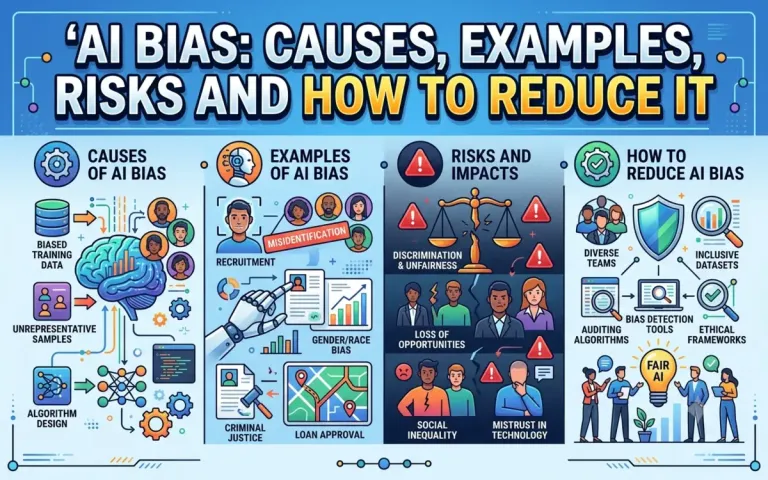
Major Causes of AI Bias
AI bias can originate from several different sources. One of the most useful ways to understand the problem is to examine bias across the AI lifecycle.
1. Historical Bias
Historical bias occurs when the data reflects existing inequalities or prejudices in society.
For example, imagine a company has historically promoted employees from a particular group more frequently. If an AI system learns from those historical promotion records, it may incorrectly conclude that characteristics associated with that group are indicators of leadership potential.
The AI has not necessarily "invented" the bias.
Instead, it has learned a pattern from historical decisions.
Historical bias is particularly difficult because simply collecting more historical data may not solve the problem. More data can sometimes provide a more detailed representation of the same underlying social inequality.
The OECD identifies historical bias as one important source of algorithmic bias.
2. Representation Bias
Representation bias occurs when certain groups are inadequately represented in the training data.
Suppose an image-recognition system is trained primarily using images representing one demographic group. Its performance may be weaker for groups that appear less frequently in the training dataset.
The problem can be expressed simply:
Underrepresented group → insufficient learning examples → lower model performance
This issue can arise in:
Facial recognition
Speech recognition
Medical imaging
Natural language processing
Customer analytics
Recommendation systems
The OECD identifies inadequate samples and the absence or partial absence of particular sub-populations as important sources of representation bias.
3. Measurement Bias
Measurement bias occurs when the variables used by an AI system do not accurately represent the underlying concept the organization wants to measure.
For example, suppose a company wants to measure employee performance but uses only the number of hours an employee spends online.
Hours online may not accurately represent:
Productivity
Creativity
Quality of work
Customer value
Problem-solving ability
The AI may therefore make a technically consistent decision based on a poor measurement of the actual objective.
The OECD identifies measurement bias as a significant source of algorithmic bias, including problems caused by inappropriate variables and proxy variables.
4. Selection Bias
Selection bias occurs when the data used to train a model is not representative of the population in which the model will eventually operate.
For example, an organization may train a customer-service AI primarily using interactions from urban customers with high-speed internet access.
If the system is then deployed across a much broader population, its performance may differ significantly.
This creates a fundamental problem:
Training population ≠ deployment population
When the two populations differ substantially, model performance and fairness may suffer.
5. Algorithmic or Computational Bias
Bias can also arise from the algorithm itself.
Machine-learning systems optimize mathematical objectives. If the objective function, model architecture, constraints, or optimization process does not adequately account for fairness or relevant population differences, the resulting system may produce systematically unequal outcomes.
NIST classifies computational and statistical bias as one of the major categories of AI bias.
It is important to understand that improving the algorithm alone may not solve every bias problem.
A sophisticated algorithm cannot automatically correct for:
Biased historical decisions
Missing data
Poor measurement
Institutional discrimination
Inappropriate deployment
Human misuse
6. Proxy Bias
A particularly important problem occurs when a variable acts as a proxy for another sensitive characteristic.
An AI system may not explicitly use a sensitive attribute, yet another variable may indirectly encode similar information.
For example, geographic information can sometimes correlate strongly with demographic characteristics. Thus, removing an explicitly sensitive variable does not necessarily eliminate the possibility of discriminatory outcomes.
The OECD identifies proxy variables as a potential source of measurement bias.
This is why simply saying "we removed the sensitive variable" is not sufficient evidence that an AI system is unbiased.
7. Evaluation Bias
An AI system may appear accurate overall while performing significantly worse for a particular subgroup.
For example:
Overall accuracy = 95%
Group A accuracy = 98%
Group B accuracy = 82%
The overall figure may look impressive, but it hides a substantial performance gap.
Therefore, organizations should evaluate AI systems not only using overall accuracy but also using appropriate subgroup and fairness measures.
NIST emphasizes the importance of identifying and managing bias throughout the AI lifecycle rather than treating it as a single technical problem.
8. Human-Cognitive Bias
AI systems do not operate in isolation. Humans design, deploy, interpret, and use them.
Human bias can therefore enter the AI lifecycle through:
Problem definition
Data selection
Feature selection
Model interpretation
Decision-making
Deployment
Human reliance on AI recommendations
NIST specifically identifies human-cognitive bias as a major category alongside systemic and computational/statistical bias.
Examples of AI Bias
Example 1: AI Recruitment
Imagine an organization develops an AI tool to rank job applicants.
The system is trained using historical recruitment and hiring data.
If historical hiring decisions contain systematic imbalances, the AI may learn patterns that correlate with previous hiring outcomes rather than genuine job performance.
Potential consequence:
Qualified candidates may receive lower rankings because the model has learned historical patterns rather than objective measures of ability.
Lesson:
Historical hiring data should not automatically be treated as an unbiased definition of future talent.
Example 2: Facial Recognition
Facial-recognition systems can perform differently across demographic groups when training and evaluation datasets are not sufficiently representative.
A difference in error rates can have serious consequences when facial recognition is used in high-impact contexts.
This demonstrates why model performance should be evaluated across relevant demographic and contextual groups rather than relying only on aggregate accuracy.
Example 3: Healthcare AI
Suppose an AI system is developed to predict which patients require additional healthcare intervention.
If the training data reflects unequal access to healthcare, differences in historical treatment may become embedded in the model.
The model could therefore learn patterns associated with historical healthcare utilization rather than actual underlying medical need.
This illustrates an important principle:
Historical healthcare data may contain historical healthcare inequalities.
Example 4: Credit and Lending
AI-based lending systems may use numerous variables to estimate credit risk.
Even when protected characteristics are excluded, other variables can sometimes act as proxies for them.
For example, geographic or socioeconomic variables may correlate with demographic characteristics.
Therefore, organizations must evaluate both the variables used by the model and the outcomes produced by the model.
Example 5: Recommendation Algorithms
Recommendation systems can also create forms of bias.
Suppose an algorithm recommends content based largely on previous user engagement.
If users have historically been exposed to a narrow range of information, the recommendation system may repeatedly reinforce similar content.
This can create a feedback loop:
Past behavior → recommendation → new behavior → more data → stronger recommendation
Thus, an algorithm can amplify an existing pattern even without intentionally designing it to do so.
Risks of AI Bias
AI bias can create several categories of risk.
1. Discrimination and Social Harm
The most obvious risk is unfair treatment of individuals or groups.
This can affect access to:
Employment
Education
Credit
Healthcare
Housing
Public services
Digital opportunities
2. Business and Financial Risk
Biased AI can lead to poor business decisions.
For example:
Incorrect customer segmentation
Poor hiring decisions
Lost customers
Ineffective marketing
Incorrect risk assessment
Reduced productivity
Increased operational costs
An AI system that appears efficient but systematically excludes profitable customer groups can ultimately damage business performance.
3. Legal and Regulatory Risk
AI systems operating in sensitive areas may create legal and regulatory exposure when they produce discriminatory outcomes or violate applicable requirements.
Organizations should therefore consider applicable laws, sector-specific requirements, contractual obligations, and internal governance standards before deploying high-impact AI systems.
4. Reputational Risk
Customers may lose trust in an organization if they discover that an AI system treats different groups unfairly.
Trust is particularly important because AI systems are often difficult for ordinary users to understand.
Once public confidence is damaged, rebuilding it can be expensive and time-consuming.
5. Reduced AI Accuracy
Bias is not merely an ethical problem.
It can also reduce model performance.
If important segments of the population are poorly represented, the model may make more errors for those users.
Consequently:
Better representation can improve both fairness and model usefulness.
6. Feedback Loops
AI systems can create self-reinforcing cycles.
For example:
AI makes a decision.
The decision influences human behavior.
The resulting behavior becomes new data.
The AI learns from that data.
The original pattern becomes stronger.
This means bias can become increasingly difficult to detect over time.
How to Reduce AI Bias
There is no single technical solution that can completely eliminate AI bias.
NIST recommends a broader socio-technical approach, recognizing that bias can originate from technical systems as well as human and systemic factors.
Organizations should therefore use a combination of technical, organizational, and governance measures.
1. Improve Data Quality and Representation
Organizations should examine whether training data adequately represents the population affected by the AI system.
Questions should include:
Who is represented?
Who is missing?
Are some groups underrepresented?
Is the data current?
Does the training data reflect the deployment environment?
Are historical inequalities present?
Better data is one of the most important foundations for reducing AI bias.
2. Conduct Data Audits
Before training an AI system, organizations should conduct systematic data audits.
A data audit can examine:
Missing values
Sampling problems
Demographic representation
Label quality
Historical patterns
Outliers
Measurement problems
Proxy variables
Data provenance
The objective is not simply to ask:
"Is the dataset large enough?"
Instead, organizations should ask:
"Is the dataset appropriate for the decision we want the AI system to make?"
3. Use Fairness Metrics
Model performance should be evaluated across relevant groups.
Depending on the application, organizations may examine:
False-positive rates
False-negative rates
Selection rates
Error rates
Precision
Recall
Calibration
Demographic disparities
There is no universal fairness metric that works for every AI application. The appropriate measure depends on the decision context and the potential harm.
4. Test AI Before Deployment
AI systems should undergo rigorous testing before being deployed in real-world environments.
Testing should include:
Representative test datasets
Edge cases
Subgroup analysis
Stress testing
Robustness testing
Human review
Scenario testing
Organizations should avoid assuming that high overall accuracy means the system is fair.
5. Conduct Continuous Monitoring
AI bias is not necessarily a one-time development problem.
A model may become less reliable when:
User behavior changes
The population changes
New data becomes available
Economic conditions change
Social conditions change
The model is used for a new purpose
NIST's AI risk-management approach emphasizes managing risks throughout the AI lifecycle rather than only at the development stage.
6. Maintain Human Oversight
Human oversight is particularly important when AI systems make or support high-impact decisions.
Human reviewers should be able to:
Question AI recommendations
Identify unusual cases
Override inappropriate outputs
Investigate errors
Escalate high-risk decisions
However, human oversight must be meaningful.
Simply placing a human in the process does not automatically eliminate bias.
7. Improve Transparency and Explainability
Organizations should document:
What the AI system is designed to do
What data it uses
What limitations it has
How performance is measured
Who is responsible for the system
How users can challenge decisions
Greater transparency can make it easier to identify and correct problematic outcomes.
8. Establish AI Governance
Organizations should develop clear policies covering:
AI system approval
Data governance
Risk classification
Fairness testing
Privacy
Security
Human oversight
Monitoring
Incident reporting
Accountability
NIST identifies fairness with harmful-bias mitigation as one of the characteristics of trustworthy AI, alongside validity, reliability, safety, security, accountability, transparency, explainability, and privacy.
9. Involve Diverse Teams
AI systems should not be designed solely from a technical perspective.
Teams may need expertise from:
Data science
Software engineering
Business management
Domain specialists
Legal and compliance
Ethics
User research
Risk management
Diverse perspectives can help identify assumptions and potential harms that a single team might overlook.
10. Document the AI Lifecycle
Organizations should maintain documentation covering:
Data sources
Data preparation
Model selection
Training procedures
Evaluation results
Known limitations
Fairness assessments
Deployment conditions
Monitoring results
Changes to the system
Documentation makes AI systems more auditable and accountable.
AI Bias Cannot Be Solved by Removing Sensitive Variables Alone
One common misconception is:
"If we remove gender, race, age, or another sensitive variable, the AI system will automatically become unbiased."
This is not necessarily true.
Other variables may contain information correlated with sensitive characteristics.
For example, geographic, socioeconomic, behavioral, or historical variables can sometimes act as proxies.
Therefore, organizations should evaluate outcomes and relationships among variables, not merely check whether sensitive variables appear in the dataset.
AI Bias vs. Human Bias
AI bias and human bias are closely connected.
| Human Bias | AI Bias |
|---|---|
| Originates in human judgment and social behavior | Can emerge from data, algorithms, design, and use |
| May be conscious or unconscious | May be intentional or unintentional |
| Can influence historical decisions | Can learn from historical decisions |
| Can be difficult to measure | Can sometimes be measured quantitatively |
| Exists in organizations and society | Can reproduce or amplify social patterns |
The relationship is important because AI systems often learn from human-generated data.
Therefore:
Biased society → biased historical data → potentially biased AI → potentially amplified outcomes
NIST's framework explicitly argues that AI bias should be understood beyond purely computational factors and should include human and systemic sources.
A Practical Framework for Managing AI Bias
Organizations can use the following lifecycle:
Step 1: Define the Problem
Clearly identify:
What decision is being automated?
Who may be affected?
What could go wrong?
What does "fair" mean in this context?
Step 2: Examine the Data
Assess:
Quality
Representation
Relevance
Historical bias
Missing information
Proxy variables
Step 3: Develop the Model
Select appropriate:
Algorithms
Features
Objectives
Constraints
Step 4: Test for Bias
Evaluate:
Overall performance
Group-level performance
Error rates
Potential disparities
Step 5: Conduct Human Review
Have domain experts examine results and unusual cases.
Step 6: Deploy Carefully
Begin with controlled deployment where appropriate rather than immediately applying the system to every decision.
Step 7: Monitor Continuously
Track:
Performance
Fairness
User complaints
Unexpected outcomes
Data changes
Step 8: Correct and Improve
When problems are identified:
Investigate the cause
Modify data or processes
Retrain the model when appropriate
Re-evaluate performance
Document the change
Why AI Bias Is a Management Issue
AI bias is sometimes treated as purely a technical problem belonging to data scientists.
That approach is incomplete.
Management decisions determine:
Why AI is being used
Which processes are automated
What data is collected
Which objectives are optimized
What level of risk is acceptable
Who is accountable
How AI decisions are reviewed
Therefore, AI bias should be treated as a strategic management and corporate governance issue, not simply as an algorithmic problem.
For businesses, responsible AI can contribute to:
Better decision quality
Greater customer trust
Reduced operational risk
Better regulatory preparedness
Stronger brand reputation
More reliable AI adoption
Conclusion
Artificial intelligence has the potential to transform business and society, but its effectiveness depends on more than technical performance.
An AI system learns from data, operates within organizational processes, and affects real people. If those data and processes contain problematic patterns, AI can reproduce or even amplify them at scale.
Consequently, managing AI bias requires a socio-technical approach that combines high-quality data, appropriate algorithms, fairness evaluation, human judgment, organizational governance, and continuous monitoring.
The future of AI should therefore not be defined simply by asking:
"How intelligent is the system?"
It should also ask:
"How fair, reliable, transparent, accountable, and responsible is the system?"
That is the foundation of trustworthy AI.
Related articles:-
Retrieval-Augmented Generation (RAG): How It Makes AI More Accurate
How AI Agents Work: Architecture, Capabilities and Applications
AI Agents vs AI Chatbots: What Is the Difference?
AI Hallucinations: Why AI Can Generate Incorrect Information
AI and Employment: How Artificial Intelligence Is Changing Jobs and Skills
Artificial Intelligence and Personal Data Privacy: Risks
Frequently Asked Questions
What is AI bias?
AI bias is the systematic tendency of an AI system to produce unfair, inaccurate, or disproportionately harmful outcomes for particular individuals or groups.
What causes AI bias?
Major causes include historical bias, representation bias, measurement bias, selection bias, computational bias, proxy variables, evaluation bias, human-cognitive bias, and systemic organizational or societal factors.
Can AI bias be completely eliminated?
Not necessarily. Bias can arise from complex social, organizational, statistical, and technical factors. The practical objective is to identify, measure, reduce, and continuously manage harmful bias.
Does removing race or gender from an AI model eliminate bias?
No. Other variables may act as proxies for sensitive characteristics. Organizations should therefore evaluate both model inputs and outcomes.
How can companies reduce AI bias?
Companies can improve data quality, conduct data and model audits, use appropriate fairness metrics, test systems across relevant groups, maintain human oversight, monitor deployed systems, document decisions, and establish AI governance.
Why is AI bias important for businesses?
Biased AI can result in poor decisions, customer dissatisfaction, legal and regulatory exposure, reputational damage, operational inefficiency, and loss of trust.
What is the role of human oversight in AI?
Human oversight provides an opportunity to question AI outputs, investigate unusual cases, correct inappropriate decisions, and manage risks that automated systems may not detect.